1.01.2014

INSIDE THE CAPITOL DOME

Our guided tour of the U.S. Capitol led us into the rotunda...


It was amazing to get the above photo; all around us were dozens of tourist groups. For one split second I was able to capture the rotunda of the U.S. Capitol like this. Right here some of the most famous Americans, including Abraham Lincoln, John Kennedy, Dwight Eisenhower, Ronald Reagan, Gerald Ford and Rosa Parks, have lain in state or lain in honor in the capitol rotunda. There is a difference: If a person is lying in state, the casket is guarded by members of the armed forces. If a person is lying in honor, the United States Capitol Police watches as a civilian honor guard.

We then looked up...
Here we saw the gorgeous dome with the fresco The Apotheosis of Washington by painter Constantino Brumidi. For 11 months following the Civil War, Brumidi painted the fresco while suspended 180 feet in the air. Amazingly it covers an area of 4,664 square feet.


George Washington is surrounded by 13 maidens in an inner ring with many Greek and Roman gods and goddesses below him in a second ring. Some of the painted figures are up to 15 feet tall.


Inside of the base of the dome below the windows is Brumidi's famous Frieze of American History. The frieze is a chronological, trompe-l'oeil pictorial depicting 19 scenes from American history, from the landing of Christopher Columbus to the Wright Brother's flight. The frieze is 8 feet 4 inches in height and approximately 300 feet in circumference. Brumidi started the frieze in 1878, but died in 1880. Two other artists continued painting the frieze until it was completed in 1953. The final scenes depicted in the fresco had not yet occurred when Brumidi began the frieze.
Above is a close-up of two scenes: on the left is Peace at the End of the Civil War which depicts a Confederate soldier and a Union soldier shaking hands at the end of the Civil War; to the right is Naval Gun Crew in the Spanish-American War.

Click here to learn more about scheduling a tour of the U.S. Capitol.

Click here to read more in depth about the Capitol rotunda.

In my next blog post I will continue our visit inside the Capitol and the beautiful dome.

All photos in this blog post were taken by my husband and me during our visit in September, 2013.

12.28.2013

OUT OF MANY, ONE...OUR VISIT TO THE U.S. CAPITOL

E Pluribus Unum

Do you know what this latin phrase means? It is on all of your coins. It's on the Seal of the United States.

It means: Out of many, one. It refers to the fact that the United States was formed as one nation as a result of the thirteen smaller colonies joining together. In recent years its meaning has also come to suggest that out of many peoples, races, religions and ancestries has emerged a single nation.

This was one of the fascinating tidbits of information we learned on our visit to the U.S. Capitol building.

To visit the Capitol building, you enter through the Capitol Visitor Center...
Walking towards the visitor's center, we get our first glimpse of the Capitol Dome...


You must schedule a specific time to tour the Capitol Building. It is free, but you must book the tour in advance. We were early for our tour so we walked around the outside. It was an cloudy Saturday morning so there was hardly anyone else around.
Such beautiful detailing in the architecture...


The dome is topped with the bronze statue of Freedom. Amazingly, the statue is 19 feet 6 inches tall and weighs approximately 15,000 pounds. She stands on a cast-iron pedestal on a globe encircled with the motto E Pluribus Unum.


Ironically the man who played a key role in the creation of the Freedom statue was at the time a slave. Whether or not he saw the last piece of the Statue of Freedom put into place on December 2, 1863, Philip Reid was by that time a free man who became a master craftsman and artisan. You can read about him here.

Click here to learn more about scheduling a tour of the U.S. Capitol.

In my next blog post I will take you inside the Capitol and the beautiful dome.

All photos in this blog post were taken by my husband and me during our visit in September, 2013.

12.18.2013

CELEBRITIES AT THE NATIONAL PORTRAIT GALLERY

Today, sports figures and celebrities leave their mark on American society as much as the industrialists, explorers, politicians and writers did in the 19th and 20th centuries.

The National Portrait Gallery displays many portraits of those persons who have inspired us in the sports arena or on the silver screen.

Muhammad Ali: a silkscreen by Andy Warhol


Muhammad Ali: oil painting by Henry C. Casselli, Jr.

Michael Jackson: synthetic polymer and silkscreen by Andy Warhol


Joe Louis: oil painting by Betsy Graves Reyneau


Oscar Robinson: February 16, 1961 Time Magazine cover by Russell Hoban


Bobby Hull: March 1, 1968 Time Magazine cover by Leroy Neiman


Arthur Ashe: acrylic on canvas by Louis Briel


L.L. Cool J: oil painting by Kehinde Wiley


Katherine Hepburn: oil painting by Everett Raymond Kinstler


In addition to this portrait of Katherine Hepburn, her unprecedented four Best Actress Academy Awards are now part of the National Portrait Gallery's permanent exhibition...


From left to right are her Academy Award for Morning Glory in 1933. Interestingly, that particular statue was the very first to be referred to by a Hollywood reporter as an Oscar. She also won in 1967 for Guess Who's Coming Dinner, the very next year for 1968's The Lion in Winter and 1981's On Golden Pond. Nearly 50 years went by between her first and last award. Note how different each statue is from the others.

The National Portrait Gallery presents the wonderful diversity of individuals who have left, and are leaving, their mark on our country and our culture. As a Smithsonian Museum, admission is always FREE at the National Portrait Gallery. Click here to visit the National Portrait Gallery's website. 

All photos in this blog post were taken by my husband and me during our visit in September, 2013.


11.23.2013

NATIONAL PORTRAIT GALLERY

On its website the National Portrait Gallery states the museum "...tells the history of America through individuals who have shaped its culture. Through the visual arts, performing arts and new media, the Portrait Gallery portrays poets and presidents, visionaries and villains, actors and activists whose lives tell the American story."

Here are some of those people...

Samuel Clemens: Who hasn't read the classic stories he wrote under his pen name Mark Twain?


Henry Clay Frick (along with his daughter, Helen): He made his fortune supplying coke for steel manufacturing; he then partnered with Andrew Carnegie to form the world's largest steel company. At his death he donated his extensive collection of European paintings to create the celebrated Frick Collection in New York City.


Andrew Carnegie: He sold his Carnegie Steel Company to J.P. Morgan which created U.S. Steel. Having built one of the world's largest fortunes, Carnegie gave away over $350 million during his lifetime, 90% of his fortune: He stated, "The individual who amasses great wealth must in the end apply his fortune for the benefit of all."


Daniel Boone: Boone spent his life pushing westward, always dissatisfied with where he was. Eventually he ended up in Kentucky, opening that area for white settlement. One reason Boone kept moving was that when the government caught up with him on the trail he had blazed, it usually voided his land claims and expelled him. Although the reality of Boone's career did not embody the romantic legend others applied to it, the persistence of Boone as a symbol indicates how strongly the idea of a lone frontiersman shaped American history.

Dave Crockett: Unlike Daniel Boone, Crockett created a totally different image of the frontiersman: a jocular, colorful type who liked tall tales and whiskey. Crockett was a soldier, state representative from Tennessee, an author and a road showman. He is however most noted for fighting, and dying, in the Battle of Alamo.


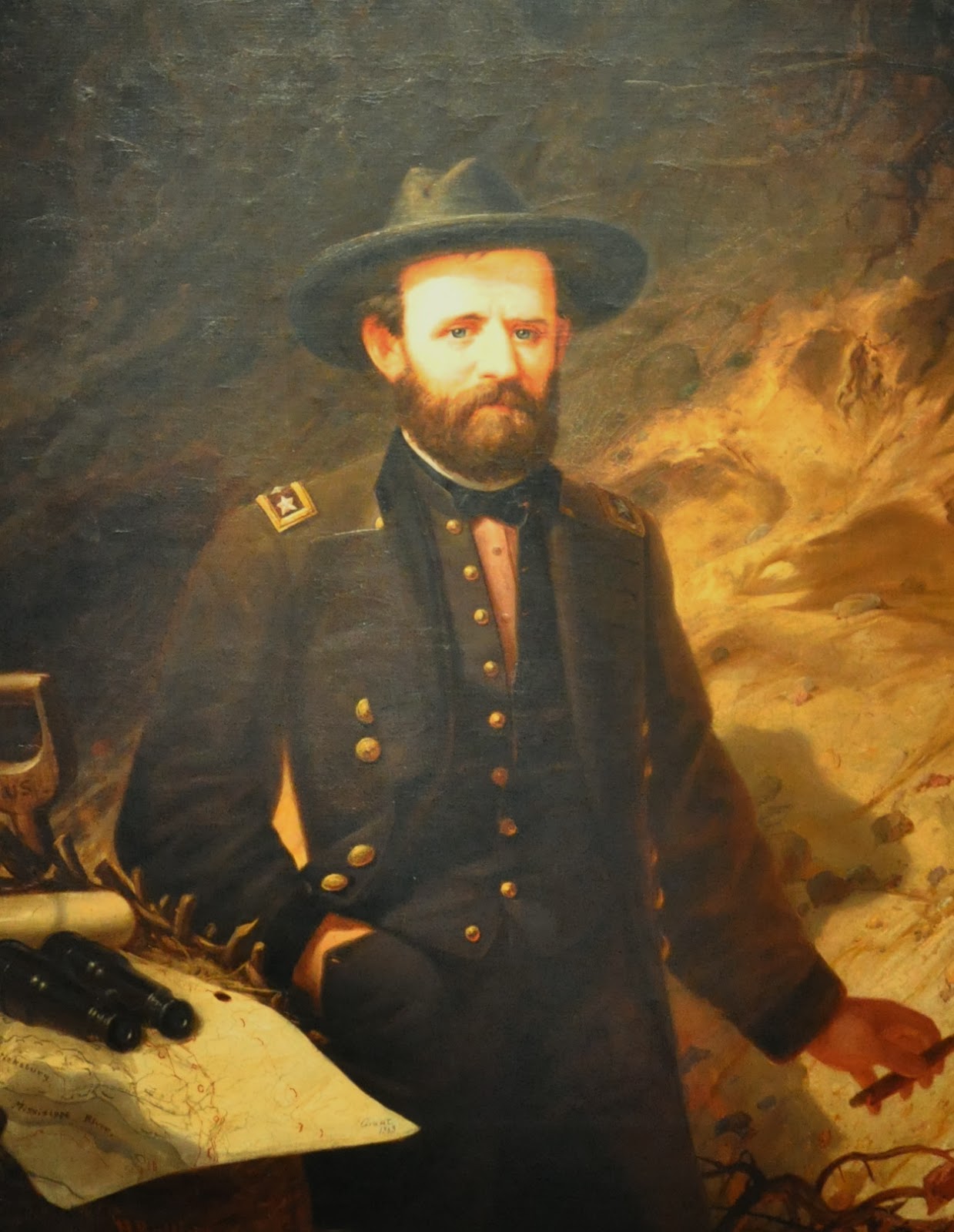
Ulysses S. Grant: Not interested in the military, Grant only entered West Point to receive an education. Unsuccessful in business ventures, he reentered the military at the beginning of the Civil War. Eventually President Lincoln made him commander of the entire Union Army. He was elected to two terms as president.


The National Portrait Gallery presents the wonderful diversity of individuals who have left, and are leaving, their mark on our country and our culture. In my next blog post I'll show you a few more.

Admission is always FREE at the National Portrait Gallery. Click here to visit the National Portrait Gallery's website. 

All photos in this blog post were taken by me during my visit in September, 2013.