9.01.2014

LINCOLN MEMORIAL

After leaving the Martin Luther King memorial, we continued on to the Lincoln Memorial.
The first idea to build the memorial began in March, 1867; however it took until 1901 before the site was chosen. By building the memorial there, it completed an idea for the open mall area from the Capitol Building to the Potomac River. In the photo below, taken from the steps of the memorial, you can see all the way past the reflecting pool to Washington Monument and the Capitol Building.


The 36 Indiana limestone columns around the memorial represent the states in the Union at the time of Lincoln's death...


The names of those 36 states are carved in the frieze; the names of the 48 states in the Union when the memorial was completed in 1922 are carved at the top of the memorial.
Designed by the acclaimed sculptor Daniel Chester French, and made from 28 marble blocks, the statue of Lincoln is 19 feet tall and 19 feet wide and sits on a 11-foot high pedestal.


A close-up of the detailing of Lincoln's face and hands...
On the walls to the left and right of Lincoln are the Gettysburg Address...


and his second Inaugural Address.
One piece of travel advice: Unfortunately the presidential and war memorials are located in areas not close to Metro stops. The nearest metro stop to the Lincoln Memorial is the Foggy Bottom stop, but it is several blocks away. My advice would be to either buy a day ticket for the Old Town Trolley orange tour (we had purchased the two-day tour pass) or try the Capital Bikeshare which has stations right across from the Lincoln Memorial, and very near the Martin Luther King memorial and the Jefferson Memorial.

All photos in this blog post were taken by my husband and me during our visit in September, 2013.

8.30.2014

HIS POWERFUL GIFT OF SPEECH...

The next stop on our memorial tour was the Martin Luther King, Jr. Memorial. 

On August 28, 2011, on the 48th anniversary of his "I Have a Dream" speech, the Martin Luther King, Jr. Memorial was supposed to be dedicated, but had to be postponed for two months because of Hurricane Irene. The dedication did occur on October 16, 2011, the 16th anniversary of the 1995 Million Man March.

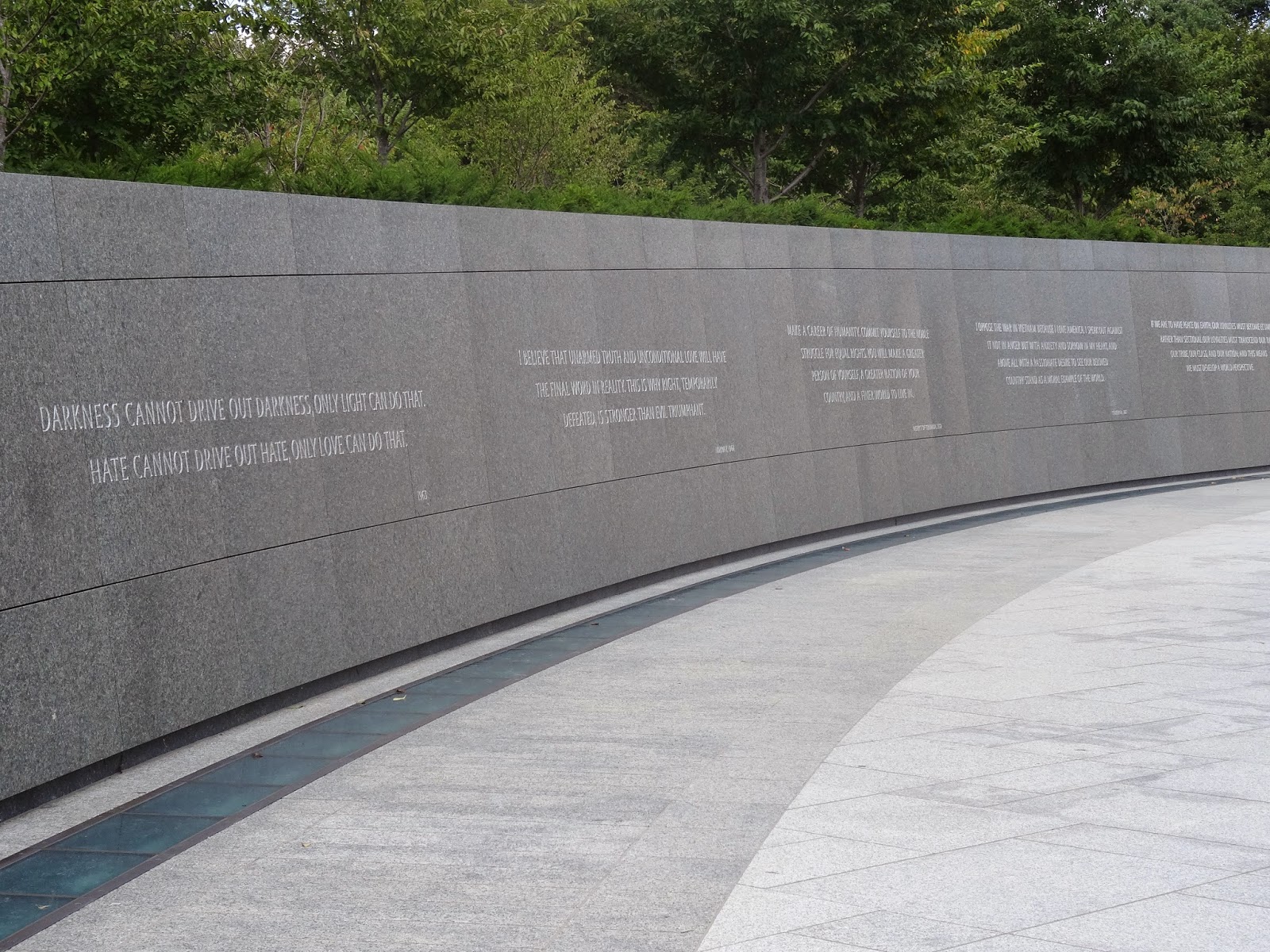
As you walk toward the memorial you see fourteen quotes from King's speeches, sermons, and writings on the 450-feet long granite wall...
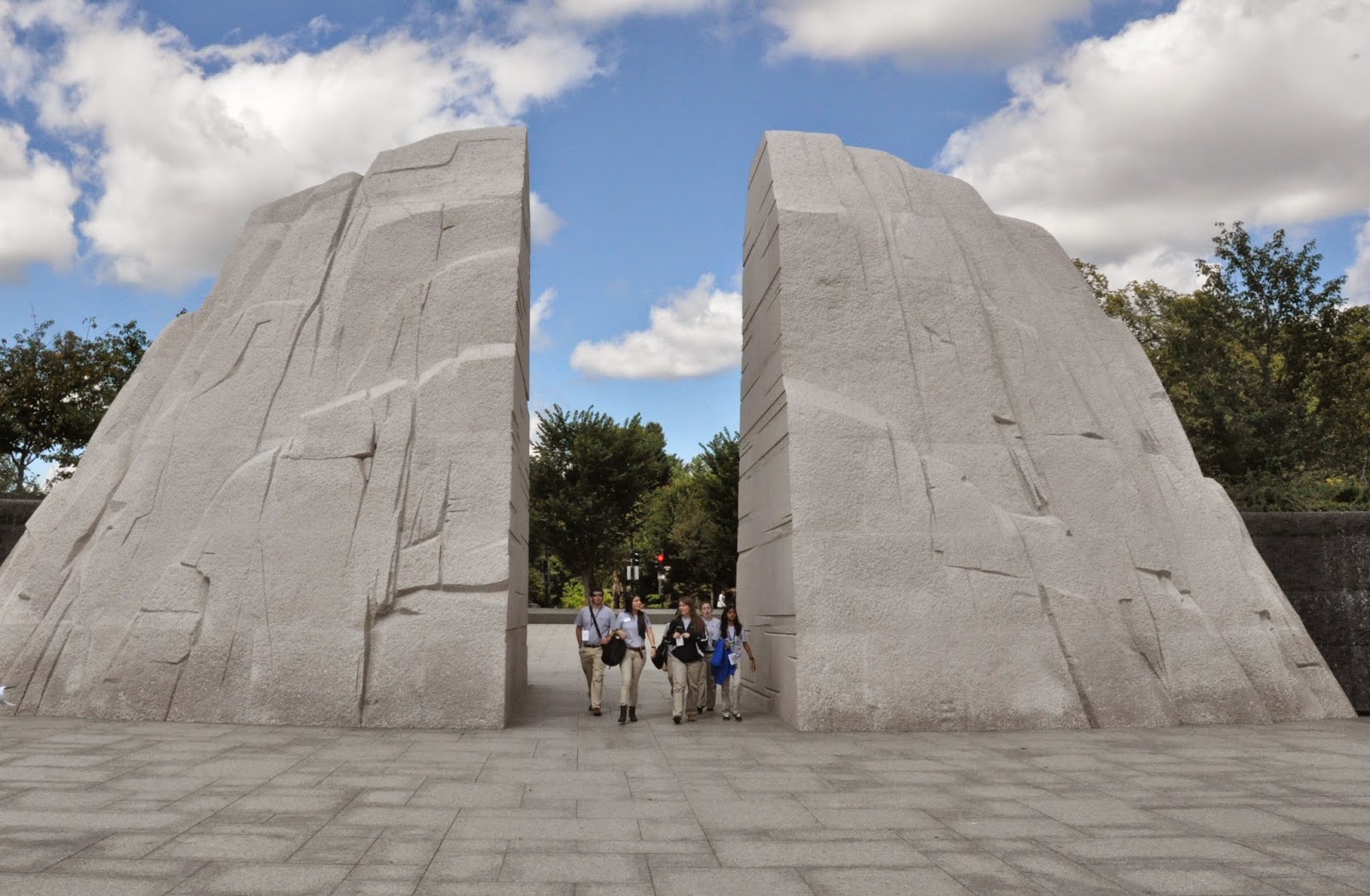
seven on each side of the "Stone of Hope".
which is based on a line from King's "I Have a Dream" speech: "Out of a mountain of despair, a stone of hope." which is inscribed on the side of the 30-foot relief of Dr. King.


Visitors figuratively walk through the Mountain of Despair on their way to the Stone of Hope, symbolically as Dr. King did during his life.
It really is an imposing sight...


The Martin Luther King, Jr. memorial is located at the intersection of Independence Ave and West Basin Drive SW. You can visit 24 hours a day. The nearest metro stop is Smithsonian.

All photos in this blog post were taken by my husband and me during our visit in September, 2013.
8.24.2014

THE JEFFERSON MEMORIAL

We spent our final full day in Washington D.C. hopping on and off our Old Town Trolley visiting all of the famous memorials. Our first stop was the Jefferson Memorial.

The drive along the Tidal Basin gives you a fabulous view of the front of the Memorial. If it had been early Spring rather than late September, the trees would have been full of cherry blossoms. Since Thomas Jefferson was such a great figure in American history, it was important to choose a prominent site for the memorial. This site created a straight north-south line with the Washington Monument and the White House which equaled the east-west line of the Lincoln Memorial, Washington Monument and Capitol Building.
A side view of the memorial...note the Washington Monument in the distance, covered entirely with scaffolding due to the damage incurred during the 2011 earthquake. The Memorial was designed by John Russell Pope, the same person Andrew Mellon asked to designed the National Gallery of Art. Pope was influenced by Jefferson's own designs: the circular colonnaded structure is reminiscent of the classic style Jefferson himself used in building design.   

A close-up view at the front of the memorial. Those red bikes in the picture are from the Capital Bike Share. Very popular with tourists, there are over 2,500 bicycles to rent at hundreds of stations all over Washington, D.C.


Washington D.C.-born sculptor Rudulph Evans was chosen to create the statue of Jefferson. The bronze statue is 19 feet tall and weighs over 5 tons. A strange fact: the original statue was made of plastic. The memorial was dedicated in 1943 (April 13, 1943, the 200th anniversary of Jefferson's birthday) during World War II, and there was a restriction on metal usage. After the war, the plastic statue was replaced with the current bronze statue.
The words inscribed in the frieze below the dome state: I have sworn upon the altar of God eternal hostility against every form of tyranny over the mind of man. This is from a letter written by Jefferson in 1800.
A close-up of Thomas Jefferson.
Also on the interior walls are inscription panels presenting excerpts from the Declaration of Independence...


Jefferson's writing on religious freedom...


education...


and the need for change in the laws and institutions of democracy...


From the Jefferson Memorial you can glimpse the Martin Luther King Memorial across the Tidal Basin. That will be my next blog post.


The Thomas Jefferson Memorial is located on the south bank of the Tidal Basin. It is open daily from 8:00 a.m. until 11:45 p.m. every day except Christmas Day. There are no fees to visit the Memorial.

All photos in this blog post were taken by my husband and me during our visit in September, 2013.

8.16.2014

THE ONLY DA VINCI IN THE AMERICAS

As I discussed in my last post, the philanthropy of the Mellon family continued with both of Andrew Mellon's children donating both works of art and funds to purchase art for the museum.

Ailsa Mellon Bruce's financial contributions allowed the museum to purchase many Old Masters, including what is currently the only painting by Leonardo da Vinci on display outside Europe. The painting was purchased for the museum from Prince Franz Joseph II of Liechtenstein in 1967.

Ginevra de’ Benci (1474/1478) by Leonardo da Vinci
Other masterpieces purchased directly by the museum thanks to the generosity of Ailsa Mellon Bruce include:

Portrait of a Merchant (1530) by Jan Gossaert


Works of art that she donated to the museum include:

The Artist's Garden at Vétheuil (1880) by Claude Monet

The Artist's Garden at Eragny (1898) by Camille Pissarro
Pont Neuf, Paris (1872) by Auguste Renoir
Riverbank (1895) by Paul Cézanne
Young Spanish Woman with a Guitar (1898) by Auguste Renoir

The National Gallery of Art is located on the National Mall between 3rd and 9th Streets along Constitution Avenue.
  • Admission is always FREE.
  • Open Monday-Saturday: 10 a.m. - 5 p.m.
  • Open Sunday: 11 a.m. - 6 p.m.
  • Closed on December 25 and January 1. 
All photos in this blog post were taken by me during my visit in September, 2013.