6.21.2014

A CHANGE IN PURCHASING STRATEGY

During Andrew Mellon's visits to London in the mid-1920s with the famous art dealer, Joseph Duveen, they would frequently visit the National Gallery in London, a state-funded art gallery that was free to the public. It is probable that during these visits Duveen pointed out to Mellon that the United States did not have a national art gallery. So it is in the winter of 1927-1928 that Andrew Mellon began to seriously plan his creation of the National Gallery of Art in Washington DC. This is when Mellon's art purchasing strategy totally changes. He would no longer purchase English and Dutch portraits and landscapes to decorate his personal homes; he would now purchase European Old Masters, Italian Renaissance paintings and religious paintings to complete a great collection that would become his founding gift to the museum.

Niccolini-Cowper Madonna (1508) by Raphael


In 1928 Mellon purchased through Duveen this exquisite Raphael (so-called for its former owners, the Niccolini family and the Earls of Cowper) for over $836,000, which at that time was the most ever spent for a painting. It is the first purchase Mellon made after his decision to create a national gallery. Raphael was considered the most highly-esteemed artist for rich American collectors at the time.

In 1930-1931 an astonishing opportunity would present itself  to Mellon which would allow him the opportunity to purchase 21 of the world's greatest masterpieces that would become the core of the collection that began the National Gallery of Art. I will write about that amazing story in my next post. 

The National Gallery of Art is located on the National Mall between 3rd and 9th Streets along Constitution Avenue.
  • Admission is always FREE.
  • Open Monday-Saturday: 10 a.m. - 5 p.m.
  • Open Sunday: 11 a.m. - 6 p.m.
  • Closed on December 25 and January 1. 
All photos in this blog post were taken by me during my visit in September, 2013.

6.10.2014

A FEW REMAINING DUTCH MASTERPIECES

It seems as if the Dutch collection at the National Gallery of Art is never ending.

In this masterpiece, purchased by Andrew Mellon in 1921, and given to the museum as part of his founding gift, Rembrandt portrays Lucretia in utter anguish, right before her act of suicide.

Lucretia (1664) by Rembrandt van Rijn


The painting below is unusual in that the costume is executed in a manner quite different from the face; whereas the facial features are modeled with delicate nuance, the costume is hinted at with a variety of bold techniques. Rembrandt’s portraits generally do not show such markedly different techniques in the face and the costume. This and other stylistic considerations are sufficient to remove the painting from Rembrandt's own oeuvre, but instead consider it painted by one of his students.

Portrait of Rembrandt (1650) by Rembrandt workshop


Jan Lievens is among the most fascinating, but least known Dutch artists of 17th-century Leiden and Amsterdam. He was a child prodigy, creating outstanding paintings before the age of 12. Many of his paintings have been attributed to his colleague Rembrandt which may explain why Lievens has not received the same acclaim now as he did during his own lifetime.

Bearded Man with a Beret (1630) by Jan Lievens


Below is yet another privately-owned painting gratefully on loan to the museum. Jan Lievens was born in 1607 which means he was only 22 or 23 years old when he did these two paintings.
 
Self-Portrait (1629-1630) by Jan Lievens


As the most important of the Utrecht Caravaggisti, the name given to Dutch painters who traveled to Italy to study Caravaggio's chiaroscuro technique, ter Brugghen was instrumental in bringing the Italian artist’s style back to the Netherlands. This painting was another work that was restituted back to its original pre-WWII owners in 2008. The purchase of this painting by the museum in 2009 was a highlight since became the first Caravaggisti painting in the museum's permanent collection.
 
Bagpipe Player (1624) by Hendrick ter Brugghen


NOTE: The museum's website recently launched their NGA Online Editions, beginning with Dutch Paintings of the Seventeenth Century by Gallery curator of Northern Baroque paintings Arthur K. Wheelock Jr. NGA Online Editions will ultimately document more than 5,000 paintings, sculptures, and decorative arts in the nation's collection. Check out more at: 

http://www.nga.gov/content/ngaweb/research/online-editions.html

The National Gallery of Art is located on the National Mall between 3rd and 9th Streets along Constitution Avenue.
  • Admission is always FREE.
  • Open Monday-Saturday: 10 a.m. - 5 p.m.
  • Open Sunday: 11 a.m. - 6 p.m.
  • Closed on December 25 and January 1. 
All photos in this blog post were taken by me during my visit in September, 2013.

6.06.2014

DUTCH STILL LIFES AND GENRE PAINTINGS

17th century Dutch genre paintings show individuals in scenes of everyday life such as letter writing, eating, drinking, or making music.

Pieter de Hooch, the most highly regarded genre painter of all, excelled in the depiction of people going about their daily lives, be it inside their houses or in urban courtyards. His use of light and color in interior scenes has been compared to the work of Johannes Vermeer, his Delft colleague.

The National Gallery of Art has two of his paintings:

A Dutch Courtyard (1660) by Pieter de Hooch


The Bedroom (1660) by Pieter de Hooch


During the nine years he spent in Haarlem, Jan Steen created many of his greatest paintings, including a number of large, complex scenes of families and merrymakers that contained lessons in morality.

 The Dancing Couple (1663) by Jan Steen


Despite the ongoing merriment in the painting above, Steen used subtle references such as cut flowers and broken eggshells to warn the viewer about the transience of sensual pleasures.

The Prayer Before the Meal (1660) by Jan Steen


The Jan Steen painting above is actually privately owned. In 2012, this painting was sold for over $9,000,000 as part of the Old Master paintings sale from the private collection at England's Sudeley Castle. At the time it was considered one of the finest paintings from the Dutch Golden Age remaining in private hands. Thank you to the buyer who lent it to the National Gallery for the public to see.

Banquet Piece with Mince Pie (1635) by Willem Claesz Heda


When the National Gallery purchased this still life painting at auction in 1991, the curators thought the painting may have been cut because of the close proximity of the oyster to the left edge of the painting. After receiving the painting the curator decided to take the painting out of the frame to check to see if the painting had been cut and surprisingly discovered not only had the painting not been cut, but it had also never been relined. This is a rarity in a painting this old.

Three other Dutch still lifes:

Still Life with Fruit (1675) by Jacob van Walscapelle


Although there is little known about his career, Jacob van Walscapelle was an accomplished still life painter. This painting measures just 16 inches by 14 inches, but it shows an elaborate composition that is usually found in larger still life paintings.

Van Walscapelle’s abundant still lifes reflect the influence of Jan Davidsz de Heem, who is considered one of the greatest Dutch still life painters. De Heem’s compositions were even more complex with large compositions of bouquets and garlands of flowers, baskets of fruit, and various motifs such as glasses, insects, and drapery.
 
The painting below is another privately-owned painting on loan to the gallery. Thank you to all private collectors for allowing the public to see the beautiful paintings you own when you lend them to public museums.

Still Life with Fruit,Oysters and Wine (1655) by Jan Davidsz de Heem

Little is known about Adriaen Coorte except that he created about one hundred paintings between 1683 and 1707. In contrast to De Heem’s elaborate compositions, Coorte's paintings were small and simply composed.

Still Life with Aspargus and Red Currants (1696) by Adriaen Coorte


I have one more blog post with a few remaining paintings from the Dutch collection.

The National Gallery of Art is located on the National Mall between 3rd and 9th Streets along Constitution Avenue.
  • Admission is always FREE.
  • Open Monday-Saturday: 10 a.m. - 5 p.m.
  • Open Sunday: 11 a.m. - 6 p.m.
  • Closed on December 25 and January 1. 
All photos in this blog post were taken by me during my visit in September, 2013.

5.18.2014

DUTCH LANDSCAPES AT THE NATIONAL GALLERY

Landscapes were a major type of painting in 17th-century Netherlands. Either as part of a gift or purchased directly by the museum, the National Gallery of Art has several superb Dutch landscapes.

River Landscape with Ferry (1649) by Salomon van Ruysdael


The painting above was originally owned by Dutch art dealer Jacques Goudstikker who fled Amsterdam during the Nazi occupation. He accidentally died on the ship on which he fled. His inventory of paintings was confiscated by the Nazis. After the war the painting was returned to the Netherlands; in 1960 it arrived at the Rijksmuseum where it remained until 2005 when it was restituted back to the Goudstikker Family. It was purchased by the museum in 2007.

A View on a High Road (1665) by Meindert Hobbema

A Wooded Landscape (1663) by Meindert Hobbema


A Farm in the Sunlight (1668) by Meindert Hobbema


Although Meindert Hobbema is viewed today as one of the premier Dutch landscape painters of the 17th century, he was basically unknown during his lifetime. Hobbema was taken on as an apprentice to the famous landscape painter Jacob van Ruisdael. In his early works Hobbema followed his mentor, but eventually developed his own style. He specialized in elaborate woodland scenes.

Herdsmen Tending Cattle (1655-1660) by Aelbert Cuyp
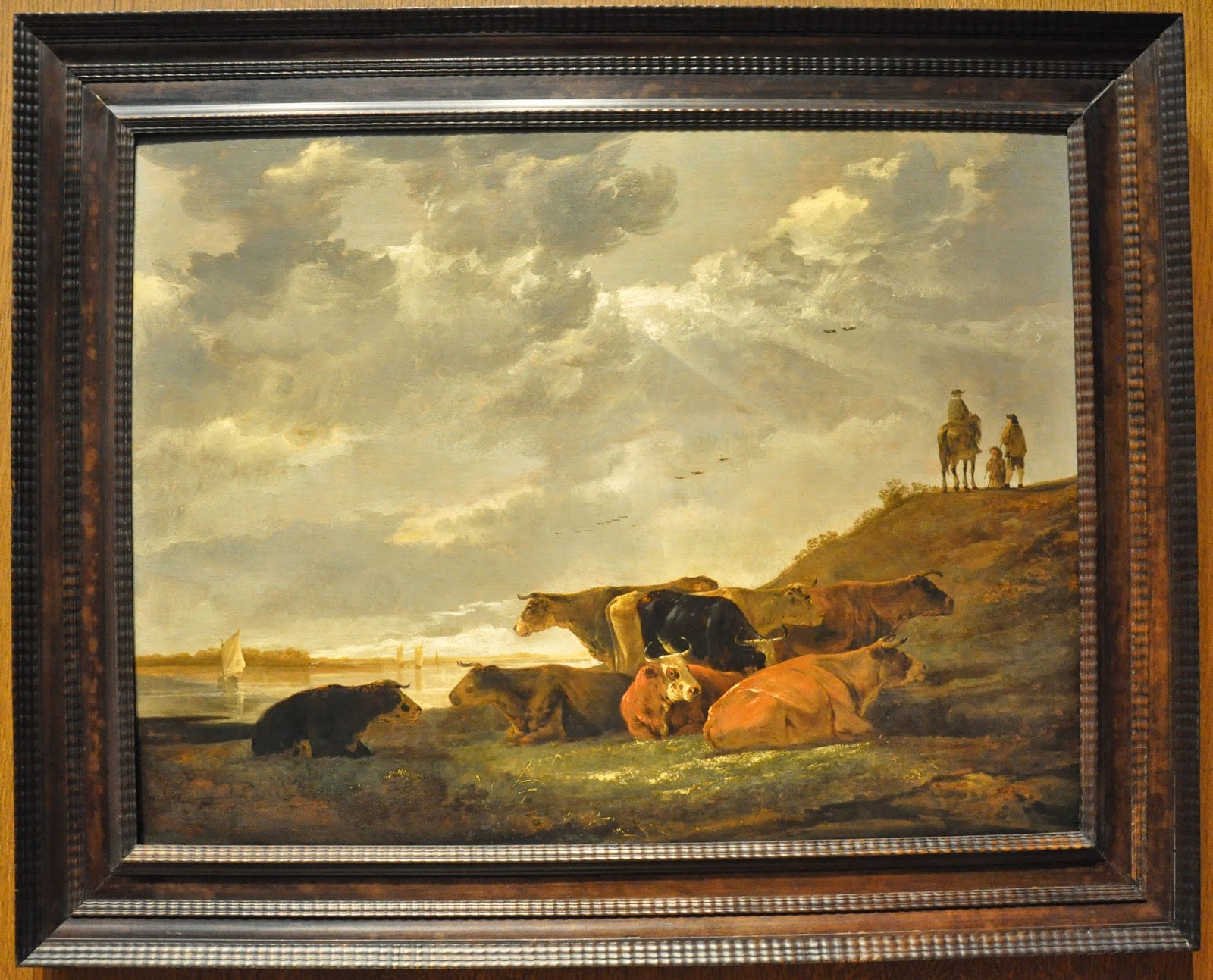
River Landscape with Cows (1645-1650) by Aelbert Cuyp


Under the threat of the Third Reich, the Petschek family, in what is now the Czech Republic, left a copy of the above painting for the Nazis to steal. The original was painted over and the family eventually escaped to the U.S. with the painting. In 1986, the family gave the painting to the National Gallery as a thank you to the U.S. for helping the family and refugees in general.

A Pier Overlooking Dordrecht (1640s) by Aelbert Cuyp (a recent gift to the museum)
The Maas at Dordrecht (1650) by Aelbert Cuyp

The masterpiece above was once rejected in the 1930s as not worthy of hanging in the Rijksmuseum in Amsterdam. Today the National Gallery of Art considers the painting one of the highlights of their museum. A change of period taste. Aelbert Cuyp, a native of Dordrecht, was one of the foremost Dutch land­scape painters of the 17th century. His father was a successful por­trait painter in the city, and from him Aelbert received his earliest training. Cuyp had also apprenticed with a landscape painter, and he soon abandoned his father’s style and subject matter and turned almost exclusively to landscapes and river­scapes. 

I will conclude my tour of the Dutch paintings in my next post, this time showing some beautiful genre and still life paintings.

Note: I normally post a photograph of just the painting in a blog post without its frame; however, the frames of many of the paintings hanging in the museum are as beautiful as the paintings. Thus, I have posted two photos of each painting: one with the frame and one without.

The National Gallery of Art is located on the National Mall between 3rd and 9th Streets along Constitution Avenue.
  • Admission is always FREE.
  • Open Monday-Saturday: 10 a.m. - 5 p.m.
  • Open Sunday: 11 a.m. - 6 p.m.
  • Closed on December 25 and January 1. 
All photos in this blog post were taken by me during my visit in September, 2013.