Showing posts with label Art Museum. Show all posts

10.28.2017

FREDERIC BAZILLE: EARLY IMPRESSIONIST

If Frédéric Bazille had not been killed in 1870 at age 28 in the Franco-Prussian war, he would have equaled Claude Monet, Edgar Degas and Auguste Renoir in fame as an Impressionist painter. He was that good.

The painting below is the famous A Studio in Les Batignolles by Henri Fantin-Latour. Along with Édouard Manet (the painter), Claude Monet, Auguste Renoir, Émile Zola and others, the very tall man on the far right of the painting is Frédéric Bazille. This shows that Bazille was part of the main Impressionist group in the 1860s and 1870s. He only fell out of the group because he died so young.
Artists often painted their studios and Frédéric Bazille was no different. Note Bazille really liked his green upholstered chair because he included it in both of these paintings.

The Studio on the Rue la Condamine (1869-1870): In this painting Édouard Manet actually painted the figure of Bazille (Bazille is the tall gentleman in the middle; Manet is in front of him.) Monet and Renoir are on the stairs but who is who has never been determined. All of the paintings Bazille included in this work had all been rejected by the Paris Salon art exhibition jury.
The Artist's Studio on the Rue de Furstenberg (1865): Bazille shared this studio with Monet. Note that this painting is all about Monet: many of the paintings that Bazille included in this painting are actually of Monet himself or paintings by Monet. None of the works on display can actually be attributed to Bazille himself.


Improvised Field Hospital (1865): Bazille painted a bed-ridden Claude Monet recuperating after injurying his leg. This painting is one of the first works which shows Bazille's genius as an artist. Bazille incorporated a variety of patterns and textures in this painting from the floral wallpaper, geometric tiles, textured wood of the bed and the plaid of the mattress. Amazingly x-rays show all this was painted with no significant changes to the composition.


La Toilette (1870): Another work where Bazille shows his attention to detail. The young, nude courtesan is the least interesting thing in the painting compared to the brilliant colors and patterns detailed in the fur on the sofa, the black woman's skirt, the kimono robe and Turkish rug in the background.  NOTE: In the painting above, The Studio on the Rue la Condamine, Bazille includes a study of this painting right above the sofa.


Oleanders (1867): In this painting Bazille experiments with the effects of sunlight and shadow in a landscape scene; here Bazille shows a succession of shadow, then bright sunshine, then back to shadow. The odd thing is Bazille later went back and started to add a green bench with a woman seated. He was never able to finish the painting before he was killed.


The Beach at Sainte-Adresse (1865): Bazille learned so much from his friendship with Claude Monet who was much more advanced in painting skills than Bazille at this time. In May 1864, Bazille and Monet traveled to Normandy (where Monet grew up). However, feeling a little intimated by Monet's superior skills at outdoor (en plein air) painting, this was the only Normandy coast painting by Bazille. And he actually painted it in his studio over a year later, actually copying a similar painting by Monet.
Note the similarities to Monet's masterpiece, The Beach at Sainte-Adresse (1864), below. (Photo courtesy Minneapolis Institute of Art). However, Monet's painting appears to have been painted in a short period of time (literally painted right there on the beach), Bazille, unfamiliar and not as experienced painting directly outdoors, painted and reworked his version inside his studio.


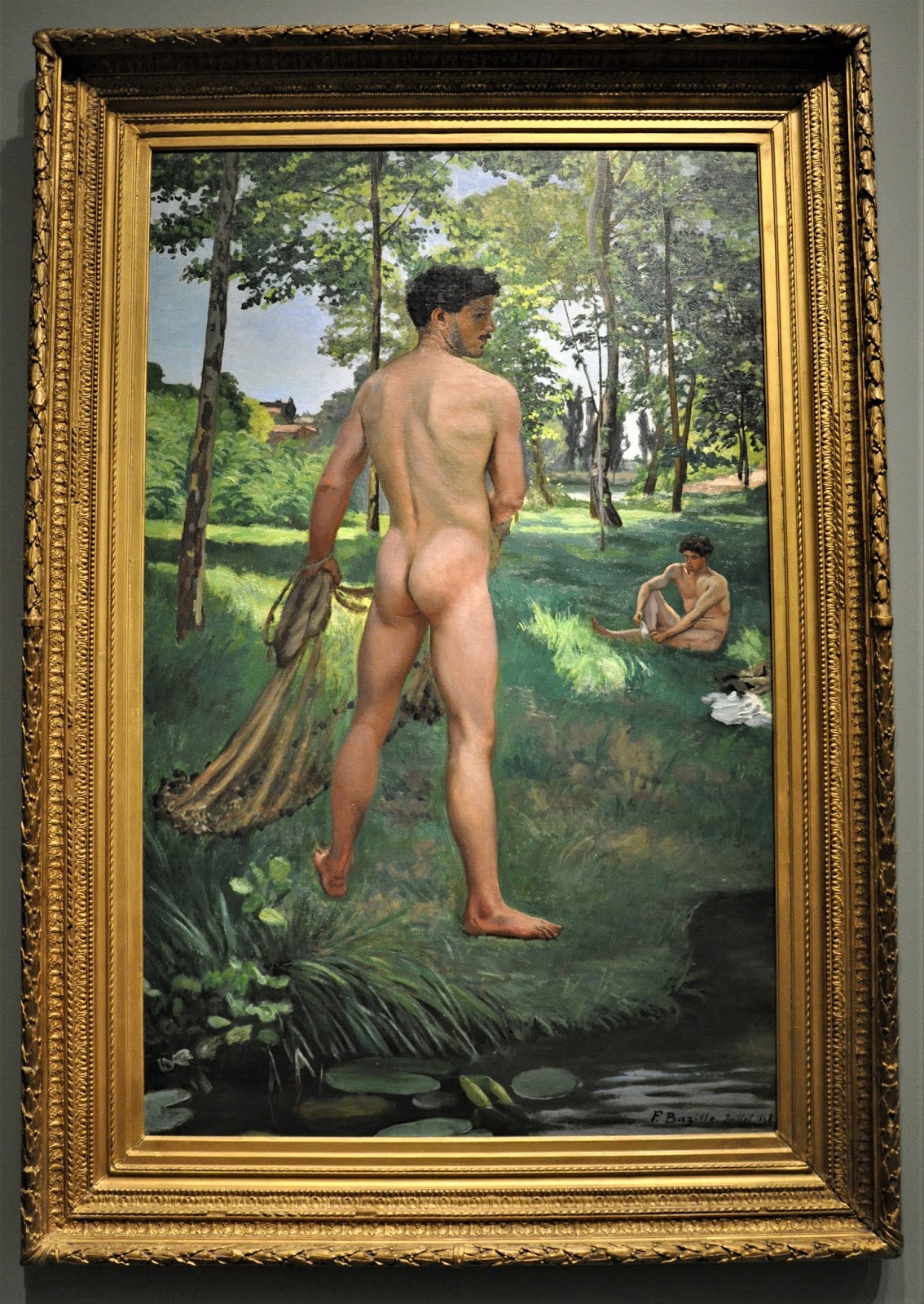
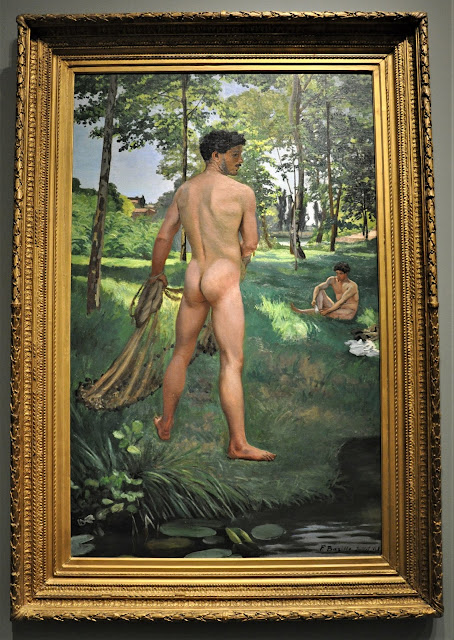
Fisherman With a Net (1868): Here Bazille expresses his beauty of the male nude. Studies of this painting also show no major alterations during its creation. It's a wonderful painting showing the juxtaposition of the bright colors in the background and the darker shades in the foreground.


Summer Scene: Bathers (1869-1870): This big painting (over 5 feet square) was Bazille's masterpiece. Much more experienced in en plein air painting at this point in his career, Bazille not only continues his interest in the *figure in the landscape*, but he also continued to experiment with the contrast between sunlight and shadow.


No one understood the reason why Frédéric Bazille felt compelled to volunteer in the Franco-Prussian War, a war France was doomed to lose from the beginning against a much more powerful Prussia. But Bazille felt himself in no danger: on November 27, 1870, while celebrating the promotion to sergeant-major, he stated, "I know for myself I won't get killed; I have too many things to do in life." Unfortunately the very next day he was killed in his first battle. Being over six feet tall probably didn't help (in the 1860s and 1870s, the average height for men was 5' 7" or 5' 8"). During his short life he only painted around 60 paintings. Despite missing success as an Impressionist painter, his work was not unknown at the time of his death, but it took some time for his work to be rediscovered (in a 1950 exhibition). Critics then and now all agree that Bazille certainly belongs with Monet, Renoir, Sisley, Degas and Morisot as one of the major founding artists of the Impressionist period.

The National Gallery of Art is located on the National Mall between 3rd and 9th Streets NW along Constitution Avenue. The entrance to the East Building is on 4th Street NW.
  • Admission is ALWAYS free (even for exhibitions).
  • Open Monday-Saturday: 10 a.m. - 5 p.m.
  • Open Sunday: 11 a,m, - 6 p.m.
  • Closed December 25 and January 1.
All photos (unless noted) were taken by me. Unauthorized use is strictly prohibited.  

10.14.2017

IMPRESSIONISTS' FLOWER PAINTINGS

During the early years of their careers the Impressionists painted many still life paintings. Still life paintings were easy and inexpensive: no need to pay a model to pose. One of the Impressionists' favorite still life subjects was flowers. All of these paintings were part of the exhibition I recently saw at the National Gallery of Art, Frédéric Bazille and The Birth of Impressionism. The flowers are so beautiful you just want to pick them out of the paintings and smell them!

Claude Monet: Spring Flowers (1864)


Henri Fantin-Latour: Pansies (1874)

Gustave Courbet: Vase of Flowers (1862)


Édouard Manet: Peony Stem and Shears (1864)


Auguste Renoir: Still Life with Spring Flowers (1864)


And all these by Bazille himself:

Flowers (1870)


Vase of Flowers on a Console (1867-1868)

Potted Flowers or Flower Study (1866)


Young Woman with Peonies (1870)

In the next post I'll show more masterpieces from the exhibition Frédéric Bazille and the Birth of Impressionism, specifically more of the paintings by Bazille himself. 

The National Gallery of Art is located on the National Mall between 3rd and 9th Streets NW along Constitution Avenue. The entrance to the East Building is on 4th Street NW.
  • Admission is always FREE.
  • Open Monday-Saturday: 10 a.m. - 5 p.m.
  • Open Sunday: 11 a.m. - 6 p.m.
  • Closed on December 25 and January 1. 
All photos in this blog post were taken by me.  Unauthorized use is prohibited.

8.02.2017

MULTIPLE MATISSE MASTERPIECES

Henri Matisse, along with his rival Pablo Picasso, revolutionized painting in the early 20th century. Like Pierre Bonnard in my last blog post, Matisse began his career in Paris, but in 1904, he visited the south of France and fell in love with bright light and colors of the area.  For several years he painted in the style known as fauvism where the painters expressed emotion with bold brushstrokes and colors.

Fauvism only lasted for a few years, but Matisse's career and fame continued to grow. He traveled to Algiers, Spain and Tangiers throughout the years and tended to alter his painting style based on what he saw in each place. He was also the victim of much criticism (one of his paintings was actually burned in effigy in Chicago in 1913). 

It was the Paris-based American collectors Leo and Gertrude Stein and the notable Russian art collector Sergei Shchukin who initially began the early support for Matisse. 

Still Life (1905): 
A perfect example of Matisse's Fauvism work, with its heavy brushstrokes and brilliant color. 

Pot of Geraniums (1912): 
Into the 1910s, Matisse continued to create works using bright colors, limited detailing and strong outlines.


Odalisque, Half-Length: The Tattoo (1923): 
In the 1920s, he reverted to more conventional "model" painting, depicting figures in exotic costumes in the textile-sheathed interior of his Nice studio.  


Still Life with Apples on a Pink Tablecloth (1924):
Matisse spent most of the 1920s living in the Nice; he incorporated many of the ideas he gathered during his past trips to Morocco such as these clashing patterns and bold color.
Still Life with Pineapple (1924):
Woman Seated in an Armchair (1940):
This painting was confiscated by the Nazis in 1941 by the Jewish French art dealer, Paul Rosenberg. It was returned to the Rosenberg family in  1948 and sold to the writer Somerset Maugham.


In the next post I will begin to show the masterpieces from the exhibition Frédéric Bazille and the Birth of Impressionism. That exhibition was the main reason for our trip to Washington DC.

The National Gallery of Art is located on the National Mall between 3rd and 9th Streets NW along Constitution Avenue. The entrance to the East Building on 4th Street NW.
  • Admission is always FREE.
  • Open Monday-Saturday: 10 a.m. - 5 p.m.
  • Open Sunday: 11 a.m. - 6 p.m.
  • Closed on December 25 and January 1. 
All photos in this blog post were taken by me during my visit in June, 2017.  Unauthorized use is prohibited.

7.16.2017

PIERRE BONNARD IN THE EAST BUILDING

Continuing on with my tour of the National Gallery of Art's East building, I exited the room with the Modigliani paintings and entered a room filled with paintings by two of my favorite painters: Pierre Bonnard and Henri Matisse.

Both artists began their careers in Paris but later they were drawn to the light and color of southern France. I love color in paintings; that's why I love the paintings of the Fauvists  and Nabis; Matisse was associated with the Fauvists; Bonnard was associated with the Nabis. These two artists' work really show how color was important to them in their works. See for yourselves...

Many of Bonnard's paintings simply focus on the everyday life around him.

Work Table (1926/1937): 
This painting was confiscated by the Nazi ERR during WWII, and selected by Herman Goering during one of his *tours* of the Jeu de Paume. It was recovered after the war and returned to France.


The Green Table (1910)


Nude in an Interior (1935): 
The detailing in this painting is remarkable: in the patterns in the wallpaper, the carpeting and the sofa.


Stairs in the Artist's Garden (1942/1944): 
This painting shows the brilliant color Bonnard found while living in the South of France.


A Spring Landscape (1935)


In the next post I will show the brilliant colors of Matisse's masterpieces.

The National Gallery of Art is located on the National Mall between 3rd and 9th Streets NW along Constitution Avenue. The entrance to the East Building is on 4th Street NW.
  • Admission is always FREE.
  • Open Monday-Saturday: 10 a.m. - 5 p.m.
  • Open Sunday: 11 a.m. - 6 p.m.
  • Closed on December 25 and January 1. 
All photos in this blog post were taken by me during my visit in June, 2017.  Unauthorized use is prohibited.

7.02.2017

MODIGLIANI IN THE EAST BUILDING

The reason for my most recent visit to Washington DC was an exhibition at the National Gallery of Art. The exhibition took place in the National Gallery's East Building which is located directly across the street from the iconic West Building.  

I'd never visited the East Building but I knew that many paintings by some of my favorite artists were in this building instead of the West Building. Some had been moved from the West Building to the East Building since my previous visit in 2013. I took the opportunity prior to seeing the planned exhibition to tour a small part of the collection. 

In one room, a small part of the Chester Dale collection, included 12 Modigliani masterpieces:


Madame Amédée: Woman with Cigarette (1918)


Nude on a Blue Cushion (1917)

Woman with Red Hair (1917)


Monsieur Deleu (1916)


Gypsy Woman with Baby (1919)


Chaim Soutine (1919)


Léon Bakst (1917)


Adrienne (Woman with Bangs) 1917


Madame Kisling (1917)


Girl in a Green Blouse (1917)


Café Singer (1917)


Nude on a Divan (1918)
Like Andrew Mellon, Chester Dale made his millions as a banker and on the New York Stock Exchange. His wife, Maud, who was a painter and art critic, introduced Chester to the idea of collecting modern art. They built the bulk of their collection rather quickly, putting the majority of their collection together between 1926 and 1933. In 1929 alone they purchased an astonishing 130 paintings. The Dales collected an amazing number of paintings by their favorites artists: 17 by Renoir; 15 by Picasso; 25 by Toulouse-Lautrec; 11 by Monet; and 21 by Modigliani. Like Andrew Mellon, Chester Dale made his millions as a banker and on the New York Stock Exchange. His wife, Maud, who was a painter and art critic, introduced Chester to the idea of collecting modern art. They built the bulk of their collection rather quickly, putting the majority of their collection together between 1926 and 1933. In 1929 alone they purchased an astonishing 130 paintings. The Dales collected an amazing number of paintings by their favorites artists: 17 by Renoir; 15 by Picasso; 25 by Toulouse-Lautrec; 11 by Monet; and 21 by Modigliani.

Modigliani painted several portraits of his artist friends such as Maurice Utrillo, Pablo Picasso and Chaim Soutine.

Modigliani's use of drink and drugs contributed to his early death at age 35 in Paris of tubercular meningitis.

I will continue to show more of my visit to the National Gallery of Art's East Building in my next blog post.

The National Gallery of Art is located on the National Mall between 3rd and 9th Streets NW along Constitution Avenue. The entrance to the East Building is on 4th Street NW.
  • Admission is always FREE.
  • Open Monday-Saturday: 10 a.m. - 5 p.m.
  • Open Sunday: 11 a.m. - 6 p.m.
  • Closed on December 25 and January 1. 
All photos in this blog post were taken by me during my visit in June, 2017.  Unauthorized use is prohibited.