Chicago is home to two of the world's best art museums, housing outstanding permanent collections: the Art Institute and the Museum of Contemporary Art. However, outside those doors, in a 4 city-block walk in the Chicago Loop are four unique pieces of art by world-famous artists.
The bright red of Alexander Calder's 53-foot-tall, 50-ton Flamingo contrasts against the three black skyscrapers that surround Federal Plaza where it sits. It was unveiled to the public on October 25, 1974, with the American sculptor present. Ironically all 3 buildings that surround the plaza were designed by Mies van der Rohe who was himself an artist with his minimalist, grid-pattern, steel and plate glass architectural designs. Calder's reputation for his large arching stabiles was the reason he was commissioned to create a piece of art work which would contrast with the rectangular modern buildings.


Walk just two blocks north on Dearborn Street to the Chase Tower's Exelon Plaza. There you will find Marc Chagall's Four Seasons mosaic. Installed in 1974 (with Chagall present), the mosaic depicts Chicago's four distinct seasons in the artist's abstract style. The 5-sided, 70-foot-long mosaic is composed of thousands of inlaid glass and stone pieces in over 250 colors from Italy, France, Norway, Belgium and Israel. It was a gift to the city by Chagall and his friends, Chicago philanthropists William and Eleanor Wood Prince. In 1994, a protective covering was installed over the mosaic because 20 years of Chicago's harsh weather had begun to do major damage to the mosaics.


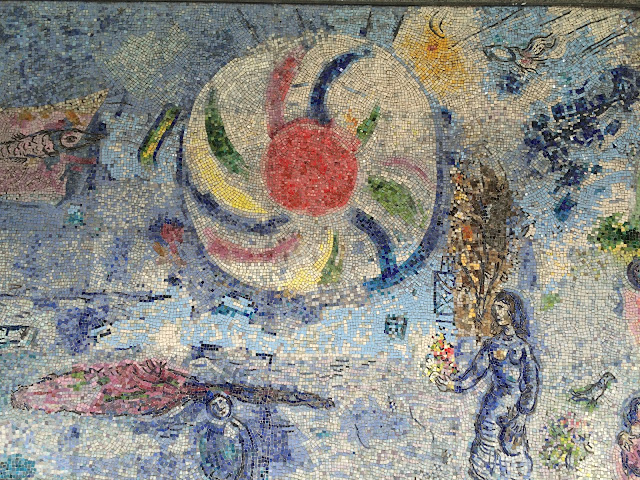

 The two end mosaics...


So you know it's a Chagall...three times.


Walk another two blocks north on Dearborn Street to Daley Plaza. Located in the middle of the plaza is Pablo Picasso's famous untitled sculpture. Commissioned by the architects of Daley Plaza in 1963, the work of art was fabricated in nearby Gary, Indiana of the same steel as on the exterior of the neighboring Daley Center, before being disassembled and relocated to Chicago. Picasso refused the $100,000 payment the city offered him; he considered the sculpture a gift to the city. When initially erected, the sculpture was certainly controversial because of its modernity. Most sculptures in major cities at that time were of historical figures. Picasso, who was 85 years old at the time he designed the sculpture, never explained what the 50-foot-tall, 162-ton sculpture represented. However, the sculpture has been described as a mixture of an Afghan dog and a woman; a bird; an aardvark; and a baboon. However many art historians believe the sculpture may be inspired by a French woman, Sylvette David, who met Picasso in 1954 and was his model for dozens of paintings. Despite its early controversy, the Picasso (as it is fondly known) is a beloved icon of the city. Children of visitors and locals alike are fond of using its high-degree-angled base as a slide.


The Picasso in Daley Plaza after an early morning rain.
 Directly across the street from Daley Plaza, in a small plaza between the Cook County Office Building and Chicago Temple Building, is a sculpture by another Spanish artist, Joan Miró. The 39-foot-tall Chicago (originally titled The Sun, the Moon and One Star) is made of steel, wire mesh, concrete, bronze and ceramic tile and faces the Picasso. Commissioned in 1969, it was abandoned due to financial issues. In 1979. then-mayor Jane Byrne agreed the city would finance one-half of the cost if private monies would finance the other half. The finished piece was unveiled on April 20, 1981.

These four pieces of art are just a small part of what can be found throughout the city. All over Chicago, in parks and plazas, visitors can enjoy a myriad of masterpieces.
Thank you for visiting,
The bright red of Alexander Calder's 53-foot-tall, 50-ton Flamingo contrasts against the three black skyscrapers that surround Federal Plaza where it sits. It was unveiled to the public on October 25, 1974, with the American sculptor present. Ironically all 3 buildings that surround the plaza were designed by Mies van der Rohe who was himself an artist with his minimalist, grid-pattern, steel and plate glass architectural designs. Calder's reputation for his large arching stabiles was the reason he was commissioned to create a piece of art work which would contrast with the rectangular modern buildings.


Walk just two blocks north on Dearborn Street to the Chase Tower's Exelon Plaza. There you will find Marc Chagall's Four Seasons mosaic. Installed in 1974 (with Chagall present), the mosaic depicts Chicago's four distinct seasons in the artist's abstract style. The 5-sided, 70-foot-long mosaic is composed of thousands of inlaid glass and stone pieces in over 250 colors from Italy, France, Norway, Belgium and Israel. It was a gift to the city by Chagall and his friends, Chicago philanthropists William and Eleanor Wood Prince. In 1994, a protective covering was installed over the mosaic because 20 years of Chicago's harsh weather had begun to do major damage to the mosaics.


Each of the four seasons...


So you know it's a Chagall...three times.


Walk another two blocks north on Dearborn Street to Daley Plaza. Located in the middle of the plaza is Pablo Picasso's famous untitled sculpture. Commissioned by the architects of Daley Plaza in 1963, the work of art was fabricated in nearby Gary, Indiana of the same steel as on the exterior of the neighboring Daley Center, before being disassembled and relocated to Chicago. Picasso refused the $100,000 payment the city offered him; he considered the sculpture a gift to the city. When initially erected, the sculpture was certainly controversial because of its modernity. Most sculptures in major cities at that time were of historical figures. Picasso, who was 85 years old at the time he designed the sculpture, never explained what the 50-foot-tall, 162-ton sculpture represented. However, the sculpture has been described as a mixture of an Afghan dog and a woman; a bird; an aardvark; and a baboon. However many art historians believe the sculpture may be inspired by a French woman, Sylvette David, who met Picasso in 1954 and was his model for dozens of paintings. Despite its early controversy, the Picasso (as it is fondly known) is a beloved icon of the city. Children of visitors and locals alike are fond of using its high-degree-angled base as a slide.


These four pieces of art are just a small part of what can be found throughout the city. All over Chicago, in parks and plazas, visitors can enjoy a myriad of masterpieces.
Thank you for visiting,
A Great Europe Trip Planner
All photos were taken by me. Unauthorized use is prohibited.


