11.20.2011

MEMORIES OF MAYMAY

We lost our beautiful, beloved cat, MayMay on Friday.  She brought such joy and happiness to our lives for over 14 years.  I loved taking photos of her especially in Black and White.  So in an effort to help me through the grieving process, here are some of my favorite photos of my pretty girl:

MayMay, this is Mommy's tribute to you.  I love you so much and my heart is breaking because I miss you so much.  I miss hearing you jump down from somewhere you shouldn't have been.  I miss hearing the tinkling of the bell on your collar when you ran down the stairs.  I miss feeling your 6-pound body walk across the bed (and me) when I was trying to sleep.  I miss you snuggling with me at night while I read before bedtime (and trying to read through you and around you).  I miss you sitting in the bathroom while I took a shower (and making sure I knew you were there), waiting for me to give you the water bowl which was within easy reach...you just wanted me to put it right in front of you which I always did.  I miss you "exercising" your paws on the basket in my bedroom.  I miss singing you those silly songs I made up about you.  I miss you greeting me when I came home from work.  I miss rubbing your tummy and scratching your back.  MayMay, I just miss you so much...

10.22.2011

S.L.A.M. aka St. Louis Art Museum

S.L.A.M.  Actually it stands for St. Louis Art Museum.

The day after visiting the Cathedral Basilica of St. Louis we visited this museum which I had never been to before.

It was another beautiful, warm autumn day in St. Louis.  The leaf colors of the trees in front of the museum were spectacular...
What a fantastic museum!  Free entrance every day!  The permanent collection has examples of all of my favorite genres of art.

My recent trip to the Netherlands has given me a greater interest in Dutch Masters paintings such as this masterpiece, Portrait of a Woman (1650-1652) by Frans Hals:
This portrait was created during a conservative phase of his career, when sober and elegant portraits were favored by the wealthy citizens of Haarlem, the city in which he painted during most of his life. This unknown woman sat for the artist together with her husband, whose portrait is now in the collection of the Nelson-Atkins Museum of Art in Kansas City, Missouri.

One of the unexpected highlights of this visit was seeing the 6-foot by 14-foot Water Lilies (1915–26) by Monet:
This mural-sized painting is part of a triptych featuring water lilies from the garden pond he created by diverting a river. For twenty-five years Monet obsessively painted the water lily motif at different times of day.  Its counterparts are currently located at the Nelson-Atkins Museum in Kansas City and at the Cleveland Museum of Art.

One of my favorite artists is Vincent van Gogh.  What a thrill to see these two masterpieces, painted in 1890 in the small town of Auvers shortly before his death.  Both paintings, Vineyards at Auvers (top) and Stairway at Auvers show the intense, heavy brushstrokes and brilliant color that make van Gogh's paintings so beautiful!


Ah!  The Impressionists...

Renoir painted this colorful portrait of a woman, titled The Dreamer, in 1879, the height of his Impressionist period...


In Promenade with the Railroad Bridge, Argenteuil, painted in 1874, Monet exemplifies key aspects of his Impressionism, notably the incorporation of industrial elements into the landscape.

Monet painted his London series, which features the Thames, railroad bridges (including this beautiful Charing Cross Bridge painted in 1903) and buildings of Parliament enveloped in a dense morning fog during three trips he made to England between 1899 and 1901.


Paul Cézanne was fascinated by the subject of The Bathers.  This version was painted between 1890 and 1892.  This painting was purchased the year Cézanne died by Claude Monet.

Edgar Degas gives color a starring role in The Milliners, painted in 1898.  Degas produced over 20 paintings and pastels of milliners, beginning in the 1870s and continuing into the 1900s.
Then there is the genius of Manet...

In The Reader, painted in 1861, Manet enlivened his dark palette with creamy whites and varied flesh tones, inspired by the 17th-century Dutch painter Frans Hals (see his painting above), whom Manet admired.


What art lover doesn't recognize a Picasso?  Facets of creamy grays, whites, pinks, and browns form a mosaic of color and tone across the body, evidence of his continued exploration of Cubist fragmentation.
Here is his Mandolin and Vase of Flowers, painted in 1934.
Picasso painted The Mother in 1901 when he was just 20 years old...


I discovered the works of Modigliani during my visit to Paris in 2006.  Modigliani was a prominent figure of the “School of Paris,” a loose group of figurative painters who worked in France after the First World War. His greatest contribution to modern art was in portraiture.  Here is his Elvira Resting At A Table, painted in 1919.


One of my favorite painters is Maurice de Vlaminck.  I love the colors in his paintings; de Vlaminck used pure color, often straight from the tubes of paint, to create his dynamic landscapes, such as here in Le Havre: Le Grand Quai painted between 1906 and 1909.


These are just a few examples of the fantastic permanent collection on display at the St. Louis Art Museum.

In my next post, I want to introduce you to the German Expressionists, a group of artists whose paintings are some of my favorites.  The St. Louis Art Museum has several excellent works of art by many of the artists associated with this movement.

St. Louis Art Museum
Forest Park, MO  63110
314.721.0072
  • Admission to the museum is free everyday.
  • Museum is closed Mondays, Thanksgiving Day, Christmas Day
  • Museum is open Tuesday through Sunday 10:00 to 5:00.
  • The museum is open Friday until 9:00.
  • For more information, visit: http://www.slam.org/

9.24.2011

83,000 SQUARE FEET OF MOSAICS

About a year ago I traveled to St. Louis for a surprise 60th birthday party for my brother.  I have always wanted to visit the Cathedral Basilica of St. Louis because of my love for both churches and mosaics (also two of my favorite things to see in Europe!).  There are over 83,000 square feet of mosaics in this church created by 20 different artists over a 75 year period.

My pictures don't do it justice; this church has to be seen in person.


Construction of the Cathedral Basilica of St. Louis began in 1907.  The architecture of the exterior is Romanesque, with granite walls, rose windows and two massive towers.  The brilliant green-tiled main dome and the pitched roofs are a prominent sight in the St. Louis skyline.

This is just the narthex...


Many of the mosaics on the narthex's walls depict the life of the patron saint of the city, Louis IX, King of France:


And the narthex's barrel vaulted ceiling is covered by a swirling green vine symbolic of Christ, who is also portrayed in the central mosaic:


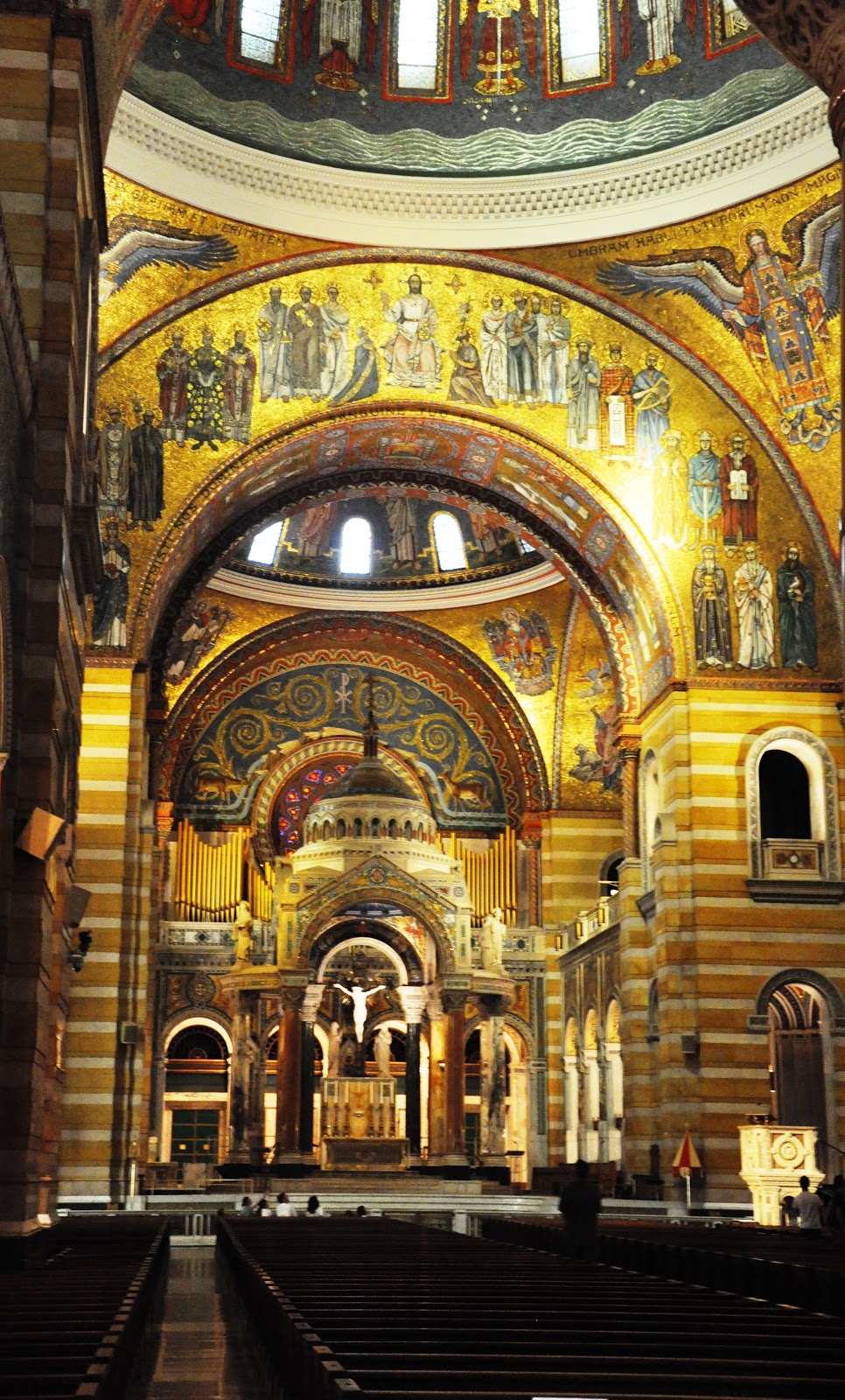
It's impossible to describe the beauty of this church.  Walking into the main part of the church, I just gasped at the incredible beauty.  Standing at the back of the church I could only marvel that every inch is covered in brilliant mosaics.


In the photo above you can just make out the red mosaics of the great central dome.  The photo below shows the central dome in all its brilliance.  The dome rises 143 feet from the floor to the central spotlight.  The mosaic panels are dedicated to, clockwise from the top: the woman of the Apocalypse; Ezekial the Prophet; the Holy Trinity; and Elias taken up to heaven in the fiery chariot.  The sixteen angels between the windows of the dome represent eight archangels and eight commemorative angels.  The four large angels of the pendentives depict, clockwise from the top right: Ecclesiastical authority; New Testament; Old Testament; and civil authority.

The great seal of the Archdiocese of St. Louis on a dark blue background and surrounded with the stars of the heavens is the dominant mosaic on the historic dome.  On these pendentives are mosaics of American saints.
The east transept mosaic portrays Christ's resurrection and His appearance to the woman, Mary, and His disciples at Emmaus.
The west transept mosaic, rendered in flaming colors of red, violet and blue pictures the occasion of the Holy Spirit's descent on the apostles inspiring them to go forth and preach the Word of God.

In the sanctuary dome mosaics picture the twelve apostles...

The dome of the baldachino imitates the main exterior dome of the Cathedral...
The white marble figure of Christ crucified dominates the sanctuary.

The red color of this ambulatory ceiling recalls the suffering of Christ...
At the end of this ambulatory is a statue of Louis IX...
The Bishop's Hall contains Italian style mosaics of the coats of arms of the men who have served as bishops and archbishops of the St. Louis diocese.

The Blessed Virgin's Chapel created by Tiffany and Company...
The All Saints Chapel is also the work of Louis Comfort Tiffany...
The magnificent Arch of Triumph has Christ the Savior as its central motif.  John the Baptist is on His left with the prophets and kings of the Old Testament and the Virgin Mary is on His right with apostles and saints of the New Testament.
This church is one of the most magnificent I've ever seen.

With mosaics as beautiful as any I've seen in anywhere...

Cathedral Basilica of St. Louis
St. Louis, MO   63108
  • Cathedral is open every day from 7:00 AM until 5:00 PM.
  • Tours are offered daily between 10:00 AM and 4:00 PM.
  • Contact the tour office at 314.373.8240 for tour reservations.
  • I encourage everyone to visit the cathedral to experience the beauty of the mosaics, but remember only tours are guaranteed to people who have reservations.
  • For more information: http://www.cathedralstl.org/