Showing posts with label Steen. Show all posts

10.15.2012

DUTCH PAINTINGS AT THE TOLEDO ART MUSEUM

After my Netherlands trip two years ago I really became enamored with paintings by the Dutch and Flemish Masters.  The Toledo Art Museum has many excellent works by the artists of the Dutch Golden Age in their permanent collection.

Van Campen Family Portrait in a Landscape (1620s) by Frans Hals
Along with Rembrandt and Vermeer, Frans Hals was one of the Netherlands' 17th-century Dutch Masters.  This painting is one of Hals' earliest examples of group family portraiture. A year or two after completing the portrait, for some unknown reason, another painter was asked to add the figure of the child in the lower left corner; the style is noticeably different from that of Hals.

Young Man with Plumed Hat (1631) by Rembrandt van Rijn
Rembrandt painted many exotically clothed character studies which he used to display his skill at depicting textures and light effects.

The Happy Child (1645-1650) by Carel Fabritius
Carel Fabritius is often considered Rembrandt's most gifted student.  Tragically he died in 1654 at the age of only 32 at the height of his career in the massive explosion of the Delft gunpowder factory.  Many of Fabritius' paintings were also destroyed in the explosion.

Allegory of Vanity (1633) by Jan Miense Molenaer
Haarlem artist Jan Miense Molenaer was one of the leading painters of genre scenes, scenes of everyday life, in the first half of the 17th century.  He was also the husband of Judith Leyster, a female artist who I have previously written about.

Peasants before an Inn (1650s) by Jan Steen
 
Like Molenaer, Jan Steen was a master of the genre scene; however, Steen became known for his boisterous scenes full of humorous anecdotes that often carried messages warning of foolish behavior.

Courtyard, Delft (1650s) by Pieter de Hooch
Like his fellow Delft painter Johannes Vermeer, Pieter de Hooch specialized in quiet scenes of Dutch domestic life especially courtyards at the back of upper middle class homes.  This painting may be de Hooch's earliest example of the subject.

Landscape with Cattle (1660s) by Salomon van Ruysdael
Salomon van Ruysdael was called De Goyer until he and his brother Isaack changed their name to Ruysdael, after the castle near their father's birthplace.  He was known for his landscapes and river scenes.

The Water Mill (1664) by Meyndert Hobbema
Meyndert Hobbema was a student of Jacob van Ruisdael (Jacob's uncle was Salomon, but Jacob spelled Ruisdael with an "i" instead of the "y".)  Hobbema specialized in forest landscapes.

Still Life with Oysters (1642) by Pieter Claesz
Pieter Claesz was one of the pioneers of a type of Dutch still life known as the "breakfast piece" which featured simple meals painted in tones of gray and brown.

Winter Scene on a Canal (1615) by Hendrick Avercamp
Hendrick Avercamp was known as the "Mute of Kampen" due to his deafness.  He was one of the first Dutch artists to specialize in winter scenes.

Supper at Emmaus (1616) by Hendrick Terbrugghen
According to the Gospel of St. Luke, after the death of Christ, two of his disciples traveling down the road to Emmaus met a stranger and invited him to join them.  At supper the stranger blessed the bread and broke it to give to the disciples.  Immediately the disciples saw the stranger was Christ risen from the dead.  After spending ten years painting in Italy Terbrugghen brought back to his native Utrecht a style with dramatic contrasts of light and shade influenced by Caravaggio.

Portrait of a Man (1630) by Anthony van Dyck
By the time he reached his twenties and after years of working as an assistant to Peter Paul Rubens, van Dyck was sought after by distinguished patrons in Britain, Italy and southern Netherlands due to the easy grace, aristocratic reserve and elegance that he imparted to his sitters.

The Crowning of St. Catherine (1631 or 1633) by Peter Paul Rubens
Peter Paul Rubens was one of the most sought-after artists during the 17th century.  Based primarily in Antwerp, Rubens was hailed as the "God of Painters".  He worked for most of the courts of Europe.

In the next post I'm going to show you my favorite American paintings plus other favorites.

For more information visit: http://www.toledomuseum.org/.

Toledo Art Museum
2445 Monroe Street
Toledo, OH   43620
Phone: 419.255.6000

For directions: click here.
  • Admission is FREE every day for all visitors.
  • There may be a charge for special exhibitions.
  • Closed Mondays.
  • Closed January 1, July 4, Thanksgiving, Christmas Day.
  • Open 10:00-4:00 on Tuesday-Thursday.
  • Open 10:00-10:00 on Friday.
  • Open 10:00-6:00 on Saturday.
  • Open 12:00-6:00 on Sunday.
NOTE: All photos of the paintings in this blog post were taken by me on my visit to the Toledo Art Museum in May, 2012.

2.09.2012

ART IN MY TOWN

I've written several posts about the world-class museums I've been fortunate to visit in my travels in Europe, but you know what?  I've got a world-class art museum right in my own backyard!  The Art Institute of Chicago.

The Art Institute of Chicago has one of the most renowned collections of paintings in the world.  But it's not just the collection inside the building that is famous.  The building that houses the collection is just as famous.  The exterior of the Art Institute is one of the most photographed buildings in Chicago, and the two huge lions that greet visitors at the entrance attract as much attention today as they did more than a century ago. 

They get decorated with wreaths every Christmas...


And they get into the spirit of special sports occasions such as when the Blackhawks won the Stanley Cup Championship in 2010.


But of course, it's the art collection everyone comes to see when they visit the museum.  Some of my most favorite paintings are part of its permanent collection:

Young Girl with Hat (1892) by Berthe Morisot


This is my absolute favorite painting in any museum, and Berthe Morisot is my favorite painter.  She was a rare female French Impressionist, painting at the same time as her colleagues Monet, Degas, Sisley, Renoir and Édouard Manet with whom she was romantically involved.  However, she married Eugene Manet, Édouard's brother.  Other excellent works by her are:

The Garden (1882) by Berthe Morisot


Woman at her Toilette (1875) by Berthe Morisot


One of the last visits I made to the museum I discovered this masterpiece which I had not seen on display previously:

Auvers, Panoramic View (1873/1875) by Paul Cézanne


Édouard Vuillard is one of my favorite painters.  The Art Institute has several wonderful examples of his work:

Annette Roussel with a Broken Chair (1900) by Édouard Vuillard


Vuillard's Room at the Château des Clayes (1932) by Édouard Vuillard

Madame Arthur Fontaine in a Pink Shawl (1904) by Édouard Vuillard

Woman seated on a Sofa (1906) by Édouard Vuillard


Vuillard was a member of a post-Impressionist group called The Nabis, a group of painters whose works I enjoy.  Nabi means prophet in Hebrew and in Arabic. The rebellious group of young student artists came together in the fall of 1888, and like many of the Impressionists and post-Impressionists, they were inspired by the broad planes of unmediated color, thick outlines, and bold patterns. Another fantastic example is:

The White Tablecloth (1926) by Pierre Bonnard


Another group of Post-Impressionist painters I like are the Fauvists (fauve means wild beast in French) also because of their use of bright, intense colors.  Excellent examples (such vivid colors!) in the Art Institute collection include:
   
Antwerp (1906) by Georges Braque


Landscape at L'Estaque (1906) by Georges Braque


Another one of my favorite paintings is by the Dutch painter, Piet Mondrian.  There is just something about the symmetry with the simple horizontal and vertical lines and colors and reflection in this painting that I find mesmerizing.

Farm near Duivendrecht (1916) by Piet Mondrain


Continuing on the Dutch theme and remembering my recent trip to the Netherlands, on my most recent visit to the Art Institute, I sought out any Dutch Masters paintings in the collection.  Jan Steen was one of the original 17th century Dutch Golden Age painters. He was known for painting scenes of daily life.  Many of the scenes he portrayed are lively to the point of chaos, so much so that a Jan Steen household, meaning a messy scene, became a Dutch proverb.

The Family Concert (1666) by Jan Steen


You can't speak about Dutch painters without mentioning Rembrandt. Throughout his career, Rembrandt painted powerful studies of single figures, conveying character through dramatic costume and lighting.

Old Man with a Gold Chain (1631) by Rembrandt Harmensz van Rijn


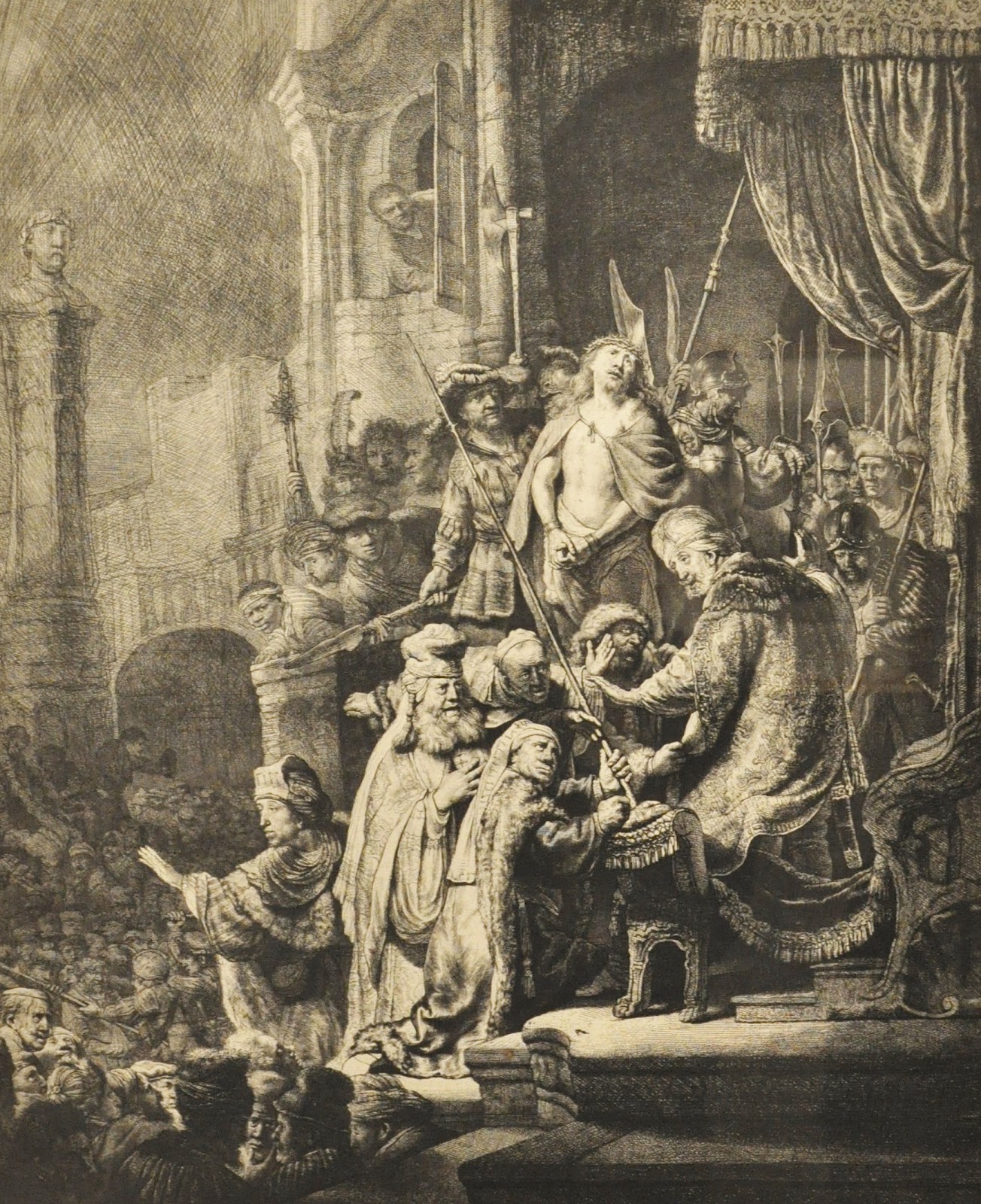
The museum has dozens of wonderful etchings by Rembrandt.  This print exemplifies the popular depiction of the Passion of Christ which often combined multiple part of the New Testament story into one overwhelming scene:

Christ Before Pilate: Large Plate (1636) by Rembrandt Harmensz van Rijn


Jan Uytenbogaert, “The Goldweigher” (1639) by Rembrandt Harmensz van Rijn

Other painters discovered on my recent Netherlands/Belgium trip were the Flemish masters, one painter being Hans Memling.  Imagine my delight in finding this diptych in the Art Institute collection.  Separated for many years, the two images were reunited in 1953.  Fortunately, the image on the left is still in wonderful condition, even after 525 years!  Unfortunately, the original matching image on the right side is in poor condition.  The image shown here on the right side is actually the back side of the original painting, Portrait of a Man in Prayer.

Virgin and Child (1485) by Hans Memling
St. Anthony of Padua (1485) by Hans Memling


Photo of the original diptych showing Portrait of a Man in Prayer.


And of course, there are the German Expressionist paintings, my love of which I wrote about in my last post.  There are some excellent German Expressionist paintings in the Art Institute's permanent collection.

Despite being raised in a country that discouraged women from careers in art, Gabriele Münter became a founding member of one of the most influential early 20th-century modernist movements: German expressionism.  In 1911 Gabriele Münter, along with Franz Marc and her lover, Wassily Kandinsky, founded the Der Blaue Reiter group, an important expressionist organization.

Still Life with Queen (1912) by Gabriele Münter


The Bewitched Mill (1913) by Franz Marc


Red-Haired Girl (1919) by Emil Nolde

Speaking of color:  You can't forget this artist:

Interior at Nice (1919 or 1920) by Henri Matisse

Women before an Aquarium (1921-1923) by Henri Matisse
 

These are just a few of my favorite paintings located in the Art Institute of Chicago.  All photos in this post were taken by me at various visits to the museum.
 
In my next post I'll continue showing many more of my favorite paintings from several different genres.
  • Admission for adults is $18.00**
  • Admission for Students and Seniors is $12.00
  • The museum is closed Thanksgiving, Christmas, and New Year’s days.
  • Open Monday, Tuesday, Wednesday 10:30-5:00.
  • Open Thursday 10:30-8:00.
  • Open Friday, Saturday, Sunday 10:30-5:00.
  • Free Family Wednesdays: Admission to the Art Institute of Chicago is free to Illinois residents the first and second Wednesday of every month.
** Chicago residents receive a $2 discount on admission in recognition of the significant support given to the museum through local property taxes. A valid photo ID with a resident address is required.

For more information, visit: http://www.artic.edu