Showing posts with label France. Show all posts

8.08.2015

WATERLOGUE WISTFULNESS

I can't believe it's been nearly 10 years since I visited Paris. But I do remember one of my favorite neighborhoods of Paris we visited was Montmartre. I bought my favorite purse there, and we ate lunch at the most charming Parisian café on Place du Tertre.

Located on charming Place Emile Goudeau, the Bateau Lavoir was made up of small painting studios occupied in the very beginning of the 20th century by some of the most famous French painters such as Juan Gris, Amadeo Modigliani, Henri Matisse, Georges Braque, André Derain, Maurice Utrillo and of course, Pablo Picasso. It is in the building that Picasso painted one of his most famous paintings, Les Demoiseles d'Avignon, considered by art historians as the beginning of his Cubist period.


If you are interested in purchasing variations of this print, please visit my Travels in Watercolor blog by clicking here.

Thank you for visiting,

A Great Europe Trip Planner 

Photo taken by me during my visit to Paris in May, 2006.
Waterlogue image created by me.
Unauthorized use is prohibited.

6.28.2015

WATERLOGUE WISTFULNESS

This week's Waterlogue wistfulness is from my trip to Paris in 2006 which was my first European trip since I was a teenager. This was one of the first photographs I took in Paris and it is one of my favorites.


Everyone takes the required photo of the Eiffel Tower, but the park area surrounding the Eiffel Tower also makes for enchanting photographs.

If you are interested in purchasing variations of this print, please visit my Travels in Watercolor blog by clicking here.

Thank you for visiting,

A Great Europe Trip Planner 

Photo taken by me during my visit to Paris in May, 2006.
Waterlogue image created by me.

12.27.2012

MORE MONET IN THE "MAGNIFIQUE" MUSEUM

The Musée d'Orsay is a world-class museum; of course, it is one of the top tourist attractions in Paris with a collection that rivals few other museums.

Ah, so many wonderful paintings by Monet!

Essai de Figure en Plein-air: Femme à l'Ombrelle Tournée vers la Gauche (1886)


The woman in the painting is Suzanne Hoschedé, daughter of Alice Hoschedé, Monet's second wife. 

La Cathédrale de Rouen; Le Portail, Soleil Matinal (1893)


The Rouen Cathedral series captures the façade of the cathedral at different times of the day and year, and reflects changes in its appearance under different lighting conditions. The Musée d'Orsay has at least 5 different paintings from Monet's Rouen Cathedral series.

Les Villas à Bordighera (1884)
Situated on the Mediterranean coast of Liguria, Bordighera attracted Monet and Renoir in 1883 in their search for new landscapes.  Monet returned alone the following year, and painted more than 40 views of the area, the town and its gardens.

Coquelicots (1873)


Monet lived in Argenteuil from 1871 until 1878. These years were a time of fulfillment for him. Supported by his dealer, Paul Durand-Ruel, Monet found in the region around his home the bright landscapes which enabled him to explore the potential of plein-air painting.

Etretat : la Plage et la Porte d'Amont (1883)


And of course, Monet's Water Lilies and Giverny paintings:

Nymphéas Bleus (1916-1919)


Le Bassin aux Nymphéas, Harmonie Verte (1899)


Le Jardin de l'Artiste à Giverny (1900)


Le Bassin aux Nymphéas, Harmonie Rose (1900)


In my next post, I'll show you more of the beautiful permanent collection in this world-class museum including beautiful works by van Gogh.

For more information visit: http://www.musee-orsay.fr.

To get to the Musée d'Orsay, use:
Metro: Line 12 to Solférino
RER: Line C to Musée d'Orsay
Bus: Lines 24, 63, 68, 69, 73, 83, 84, 94


  • Regular admission is 9.00.
  • FREE with your Paris Museum Pass.
  • There may be a charge for special exhibitions.
  • Closed Mondays.
  • Closed January 1, May 1, Christmas Day.
  • Open 9:30-6:00 on Tuesday-Thursday.
  • Open 9:30-9:45 on Thursday

NOTE: All photos of the paintings in this blog post were taken by me on my visit to the Musée d'Orsay in May, 2006.

5.08.2012

IN THE GARDEN OF HÔTEL BIRON

The Hôtel Biron is the beautiful 18th-century mansion that houses the Musée Rodin in Paris.  The museum opened its doors in 1919, two years after Auguste Rodin died.  In 1753, the mansion, built between 1728 and 1730, was sold to Maréchal de Biron, who gave it its present name.   


In 1820, the Society of the Sacred Heart of Jesus became the owners of the property.  Its vocation was to educate the young girls of high society.  The mansion was stripped of all its embellishments and the gardens were allowed to grow wild.  The Society of the Sacred Heart of Jesus was dissolved in July, 1904, and the sisters were evicted. While awaiting a buyer, the Hôtel Biron was rented out to artists.  Its illustrious tenants included Isadora Duncan and Henri Matisse.  When the poet, Rainer Maria Rilke, who was Rodin's secretary, wrote to him about the mansion and abandoned gardens, Rodin rented four of the mansion's rooms in October of 1908 as his studio; by 1911, Rodin occupied the entire mansion.
Rodin loved the tangle of plants.  In 1908, Rodin first started placing some of his sculptures in the overgrown garden in addition to some of the ancient works of art from Egypt, Greece and Rome that he began collecting in the early 1890s. 

“Nature and Antiquity are the two great sources of life for an artist. In any event, Antiquity implies nature. It is its truth and its smile.”    Auguste Rodin (taken from www.musee-rodin.fr)


In 1910, the government of France purchased the property, initially to house the Department of Civil Buildings.  However, Rodin successfully negotiated with the French government; he would donate all his works to France under the stipulation that the French government keep the collection at Hôtel Biron:


“I give the State all my works in plaster, marble, bronze and stone, and my drawings, as well as the collection of antiquities that I had such pleasure in assembling for the education and training of artists and workers. And I ask the State to keep all these collections in the Hôtel Biron, which will be the Musée Rodin, reserving the right to reside there all my life.”   

Auguste Rodin - Correspondence of Rodin, volume III, 1908-1912, letter no. 103 to Paul Escudier, late 1909  (taken from www.musee-rodin.fr)

In 1916 the French legislature accepted Rodin's gift; the Musée Rodin opened its doors on August 4, 1919.

The first bronzes were placed in the gardens before World War I.   The large-scale Le Penseur (The Thinker) was transferred with its pedestal to the museum in 1922.  This image of a man lost in thought has become one of the most celebrated sculptures ever known.


The Thinker was eventually accompanied by an enlargement of Ugolino, set in the middle of the ornamental pool in 1927...


then by Les Bourgeois de Calais (Burgers of Calais) in 1937...


The statue of Balzac, an old bronze cast before 1936, was installed much later.  When the statue was originally unveiled, the crowd booed, a fitting tribute to the defiant writer.


In the 1993 restoration of the garden, which is spread over an area of three hectares, the landscape architect decided to keep the classical layout of the garden.  A large number of bronze sculptures are displayed throughout in the renovated gardens.   

Meditation with Arms


Fallen Caryatid with Urn


The Three Shades (the souls of the damned): a larger version of what sits on top of The Gates of Hell.


The Shade: a sculpture in which Rodin depicted most fully the lessons he had learned from the study of the works of Michelangelo during his visits to Italy.


Many visitors to Paris miss this wonderful museum dedicated to the works of one of the most talented sculptors in history.  They concentrate on Musée d'Orsay or the Musée du Louvre.  Even if you don't walk through the mansion, take a stroll through the gardens where many of Rodin's most important works are displayed among some of most beautiful flowers you will see in Paris.
Musée Rodin has partially reopened after being closed for the last three months.  A temporary presentation of the permanent collection called Masterpieces on the Move shows the most important works by Rodin and Camille Claudel in the east wing of the museum.  The west wing of the museum is closed until April, 2013.

Musée Rodin
79 Rue du Varenne, 75007 Paris 

Phone: +33 (0)1 44 18 61 10
Fax:     +33 (0)1 44 18 61 30 

Metro: Varenne (Line 13) or Invalides (Line 13, Line 8)
R.E.R:  Invalides (line C)
Bus:    69, 82, 87, 92

  • Admission fee is €6.00
  • Admission fee with temporary exhibit is €9.00
  • Admission fee for the gardens is €1.00
  • TIP: You should use your Paris Museum Pass.
  • Open Tuesday-Sunday 10:00-5:45 (last ticket sold 5:15).
  • Beginning April 3, 2012 Open Wednesday until 8:45. 
  • Closed Mondays.
  • Closed January 1, May 1 and December 25.

For more information visit the website: http://www.musee-rodin.fr/

NOTE: All photos in this post were taken by me during my visit in May, 2006.

2.27.2011

TWO WOMEN PAINTERS

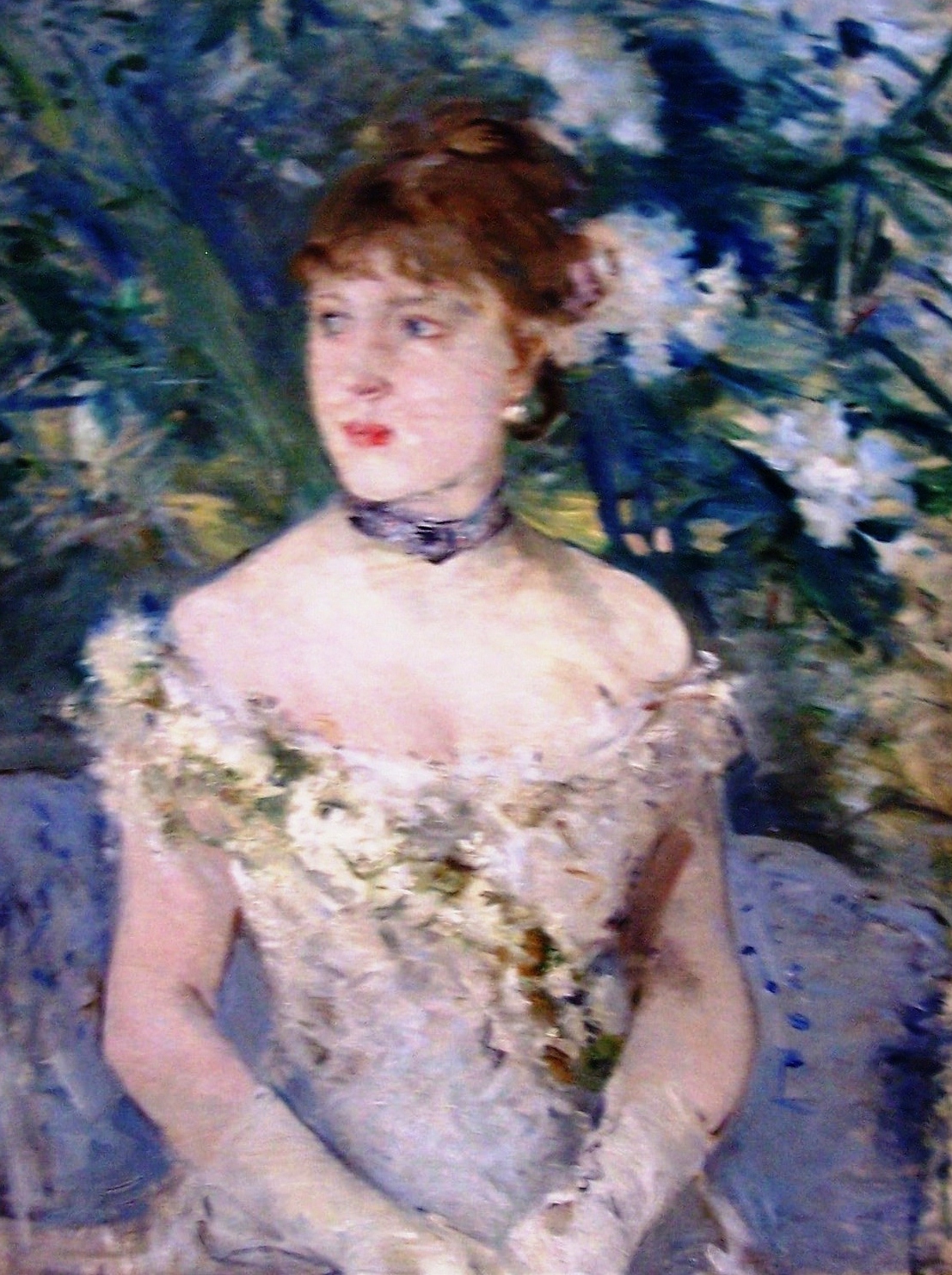
All you art lovers should be familiar with the names of the Impressionist painters of Monet, Renoir, Pissarro and Sisley.  But are you familiar with the works of Berthe Morisot?  All you art lovers should be familiar with the Dutch master painters Rembrandt, Vermeer and Frans Hals.  But are you familiar with the works of Judith Leyster?

Berthe Morisot identified herself as an impressionist, that group of 19th-century French artists who rebelled against the Salon and the academic works exhibited there. Associated with Monet, Renoir, and Degas, Morisot was included in all but one of the impressionist exhibitions held between 1874 and 1886. Although associated with the renegade group, as a woman Morisot often escaped the unfavorable judgments the other artists received.  Most 19th and 20th-century critics focused on the "feminine" qualities in her work: intuitiveness and delicacy. Morisot is generally considered one of the most important woman painters of the late 19th century.

Morisot achieved significant recognition during her lifetime. Her work was included in George Petit's International Exhibition and in Paul Durand-Ruel's exhibition of impressionist painting in New York, both in 1887.  She was married to Eugène Manet, although previous to her marriage, she was romantically involved with Édouard Manet; the famous painter was her soul mate, but unfortunately married to someone else.

Her works can be found in the museums in Paris and around the world:

Jeune Femme en Toilette de Bal in the Musèe d'Orsay


Woman in a Garden in the Art Institute of Chicago


In the Garden at Maurecourt in the Toledo Art Museum


Judith Leyster was born in 1609 into the family of a brewer in Haarlem, a town just outside of Amsterdam. She is one of the very few women to be accepted as a member to the Haarlem Guild of Painters--the only woman master-painter of her day and one of the few women artists of the 17th-century to earn her living as a painter. Although she was highly esteemed by her contemporaries, she remained unknown for a long time and her works were either believed lost, or were attributed to the famous Haarlem Dutch painter Frans Hals. Judith was believed to be Hals’ pupil; she worked in his studio in Haarlem in about 1630; at that period she tried to follow his style.

Her work was clearly influenced by the content and style of genre paintings created by Frans Hals. Like them, Leyster had a talent for painting lively scenes of people enjoying themselves in taverns, playing music, and the like. Such subjects were very popular with Holland's newly prosperous middle class, the principal buyers of contemporary Dutch art.

Leyster produced most of her paintings between 1629 and 1635; her artistic output decreased dramatically after her marriage in 1636 to the painter Jan Miense Molenaer. The couple soon moved to Amsterdam and had at least five children. By 1649 the family was back in Haarlem, where Leyster spent the remainder of her life.

Although well known during her lifetime, Leyster and her work were largely forgotten after her death until 1893, when a painting acquired by the Louvre was found to have Leyster's distinctive monogram (her initials entwined with a five-pointed star) hidden under a false signature reading "Frans Hals." This discovery led to renewed research and appreciation of Leyster's oeuvre, which had previously been confused with that of Hals.

Her works can be found in several museums in Netherlands:

Monsieur Pekelharing at the Frans Hals Museum © Frans Hals Museum


Serenade at the Rijksmuseum © Rijksmuseum


Man Offering Money to a Young Woman in the Mauritshuis ©Mauritsuhuis

1.22.2011

WHY THE FRENCH CITIZENS REVOLTED...

The Palace of Versailles is a palace so naturally the furnishings and decor are fit for a king. How opulent? Just looking at the ceilings of the various rooms, I came away with the knowledge of why the French citizens revolted causing the French Revolution of 1789.

Impressions begin the minute you enter the palace. The first room you see is the two-story Royal Chapel with a gorgeous painted ceiling by the painters Jouvent, Coypel and La Fosse:


Move on to the Hercules Room. The ceiling painting, done by Lemoyne over a period of three years (he killed himself after it was finished), shows Hercules being crowned a god:

Love ruled at Versailles. In the Venus room, couples would cavort beneath the Greek goddess of love (on the ceiling), who sent down a canopy of golden garlands to ensnare mortals in delicious amoré:
Decorated with a military flair, the Mars Room's ceiling, painted by Audran, Jouvenet and Houasse, has the Greek god of war in a chariot pulled by wolves:


In the Apollo Room, the throne stood on a central platform beneath the ceiling showing the sun god driving his chariot across the heavens:


There's also the Queen's antechamber ceiling: 
The coronation room's ceiling:


And of course, the room of all rooms which isn't really known for its ceiling, the Hall of Mirrors. Here, Le Brun executed the most important work of his career as the king's chief painter.

 BASIC INFORMATION:
  • Château de Versailles is closed on Mondays.
  • Also closed on 1/1, 4/5, 5/1, 5/24, 11/1, 12/25.
  • 11/1-3/31: Open Tuesday thru Sunday from 9:00-17:30.
  • 4/1-10/31: Open Tuesday thru Sunday from 9:00-18:30.
  • You should use your Paris Museum Pass at this museum.
  • For various other ticket options, visit the website.
  • Photography is allowed.

11.26.2010

IF YOU LOVE MONET, DON'T MISS THIS MUSEUM!

Almost everyone who loves art loves Claude Monet's paintings. The beautiful paintings of his waterlilies, the "series" he created of the haystacks, Rouen cathedral, Charing Cross bridge, Venice, and poplar trees. 

If you love art and you are visiting Paris, the Musée d'Orsay, with dozens of Monet paintings, is probably at the top of your sightseeing list. But if you love Monet, don't miss another must-see museum, the Musée Marmottan Monet, which houses the largest collection of Monet works in the world.


In 1957, the museum was fortunate to receive a large donation from the private collection of Mrs. Victorine Donop Monchy which she inherited from her father, Dr. George Bellio. Dr. Bellio had purchased or been given these paintings as tokens of appreciation for the patients he cared for, some of whom were Édouard Manet, Camille Pissarro, Alfred Sisley, Pierre Renoir and Claude Monet. One was the painting that gave the movement its name, Impression, Sunrise.

Impression, Sunrise by Claude Monet                                                                                                  Photo: http://www.marmottan.com/

In 1966, Claude Monet's son, Michel, bequeathed his inherited collection of 150 of his father's paintings to the museum. This donation endowed the museum with the largest Monet collection in the world. The museum now possesses nearly 300 works by Monet.

The Train in the Snow by Claude Monet                                                                                                  Photo: http://www.marmottan.com/


Jacque Carlu, then curator of the museum, built a special exhibition space for the Monet collection in a lower level of the museum. Reminiscent of the hall designed for Monet's Water Lilies murals in the Musée de l'Orangerie, the special exhibition space is a large, open room space which allows visitors to follow the significant stages of the Monet's path as a painter and follow the evolution of his technique and the progression of his work, as well as to view his canvases both up close and from afar. Several works were painted between the years 1919 and 1923 when his eyes were suffering from cataracts. Monet finally had an operation to remove the cataracts and was able to resume his painting; he mainly concentrated on his Water Lilies murals found in the Musée de l'Orangerie.

Musée Marmottan Monet also has an exquisite collection of Impressionist paintings by other artists. In 1987, the museum was again the recipient of a outstanding private collection of paintings. Educated as a lawyer in the 1890s, Henri Duhem renounced his career to devote himself completely to painting. Duhem was also a passionate collector. He acquired many paintings, many by his artist friends and succeeded in forming a very impressive collection consisting of paintings, pastels and sculptures by Boudin, Corot, Gauguin, Guillaumin, Monet, Pissarro, Renoir and Rodin. Following the wishes of her adoptive parents, daughter Nelly Sergeant-Duhem donated the entire collection to the museum in 1987.

And most recently in 1996, the museum was again the recipient of one of the most important French collections of avant-garde paintings when Denis and Annie Rouart donated their collection of prestigious works by Berthe Morisot, Édouard Manet and Edgar Degas. This collection had special meaning to the Rouarts. Denis Rouart was the son of Julie Manet who was the daughter and only child of Eugène Manet (Édouard's brother) and Berthe Morisot. Denis inherited the collection directly from his grandmother, Berthe Morisot. The museum now holds over 80 works by Berthe Morisot. (A personal note: Berthe Morisot is my favorite painter.)

Eugène Manet and his Daughter in the Garden of Bougival by Berthe Morisot                                   Photo: http://www.marmottan.com/


Rose Trémière by Berthe Morisot                                                                         Photo: http://www.marmottan.com/


GETTING TO THE MUSEUM:

Directions: Take Métro Line #9 (Direction: Pont des Sèvres) to the La Muette stop. Exiting the Métro station, follow the brown signs down Chaussée de la Muette which turns into Avenue du Ranelagh. Turn right onto Avenue Raphaël then left onto Rue de Boilly. You can also cut through the park with the children's carousel to the museum. The museum is located at Rue de Boilly 2.

Musée Marmottan Monet located on Rue de Boilly.


BASIC INFORMATION:
  • Musée Marmottan Monet is closed on Mondays.
  • Open Tuesday from 11:00 - 21:00.
  • Open Wednesday through Sunday 11:00 - 18:00.
  • Paris Museum Pass cannot be used at this museum.
  • The current entrance fee is €9.00.
  • No photography is allowed.

9.17.2010

MONET'S GIVERNY

Monet landscapes. Water lily gardens. Where else but Giverny.

Monet's Arrival of the Normandy Train, Gare Saint-Lazare (1877) in Art Institute of Chicago


Less than an hour's train ride out of Paris' Gare St. Lazare is Giverny, the village home of Claude Monet.  Monet permanently moved to Giverny in 1883.  He would live there for 43 years and is buried there.


The surrounding countryside of farmland, orchards and low rolling hills, plus the abundance of water inspired Monet to paint many of the paintings that we have come to know and love.

PLEASE NOTE: The house and gardens of Claude Monet are only open April 1st through November 1st.

GETTING THERE:
To visit Giverny, take the Mètro to Gare St. Lazare. Follow the "SNCF-Grandes Lignes" signs to purchase a roundtrip ticket to the village of Vernon. The Voyages-SNCF website currently shows direct trains departing Gare St. Lazare every two hours beginning at 8:20, then 10:20,12:20 and so on. The current roundtrip ticket price is €25.80.

Once you arrive at the Vernon train station, walk to the parking lot to the waiting T.V.S. shuttle bus.  The 15-minute bus ride will take you to Giverny.  The current roundtrip bus ticket costs €4.00.  You can check the bus shuttle timetable for the times the bus runs on specific days.  The bus will drop you off in the Giverny parking lot.  To reach the village you will need to cross the road via the tunnel path under the road.  The current entrance fee to Monet's house and gardens is €6.00.  In Giverny, you can:

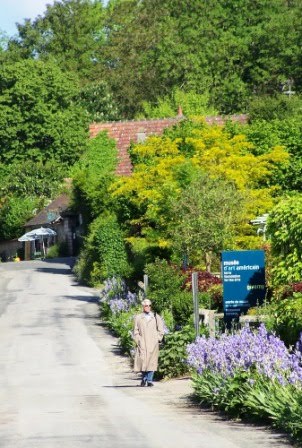
Stroll down a country lane:


Tour Monet's home:


Meander down the garden's paths:

 
Marvel at nature's beauty in Monet's garden:


Stroll around the actual water lily pond:

Admire more gardens...


Eat lunch at The Terra Café:

My lunch was so colorful that I had to take its picture!


Visit the country church where Monet and his family are buried...


Pay homage to the genius.

Aren't you glad that Claude Monet discovered Giverny and decided to permanently move to this village? Judging by the paintings below, it was the right decision.

Poppy Field-Giverny (1890-1891) at the Art Institute of Chicago

Water Lilies (1917-1922) at the Art Institute of Chicago

Water Lilies (1906) at the Art Institute of Chicago

Branch of the Seine near Giverny (Mist) part of the Mornings on the Seine series (1897) at the Art Institute of Chicago
    
Le Bassin aux Nymphéas, harmonie rose (1900) at Musée d'Orsay


Le jardin de l'artiste á Giverny (1900) at Musée d'Orsay