Showing posts with label Museums. Show all posts

6.29.2014

MODIGLIANI PORTRAITS IN THE DALE COLLECTION

Like Andrew Mellon, Chester Dale made his millions as a banker and on the New York Stock Exchange. His wife, Maud, who was a painter and art critic, introduced Chester to the idea of collecting modern art. They built the bulk of their collection rather quickly, putting the majority of their collection together between 1926 and 1933. In 1929 alone they purchased an astonishing 130 paintings. The Dales collected an amazing number of paintings by their favorites artists: 17 by Renoir; 15 by Picasso; 25 by Toulouse-Lautrec; 11 by Monet; and 21 by Modigliani.

Once the National Gallery opened in 1941, the Dales began to lend and donate paintings to the museum. When Chester Dale died in 1962, he bequeathed the remainder of his collection to the National Gallery. The Dale collection is comprised of over 300 works, mostly modern French art. The gift nearly tripled the gallery's 19th-century French collection, but the dazzling quality of the gift was even more noteworthy than its quantity. Virtually every major artist who worked in Paris from the  mid-1800s to mid-1900s is represented.

Portraiture dominates the Dale collection, largely owing to the influence of Maud. She felt portraiture, more than any other genre of art, was a reflection not only of the artist and the sitter but also of the era in which they lived.

Maud Dale favored portraits painted by Amedeo Modigliani. She organized exhibitions featuring his work and published one of the very first monographs on the artist in 1929. The Dales eventually collected 21 of what critics considered to be the finest works by Modigliani. Thirteen of these works are now in the collection of the National Gallery of Art. Four were on display during my visit.

Nude on a Blue Cushion (1917)
Modigliani was renowned for his languorous nudes. An exhibition in 1918 in Paris was closed by the police on the grounds of obscenity.

Gypsy Woman with Baby (1919)

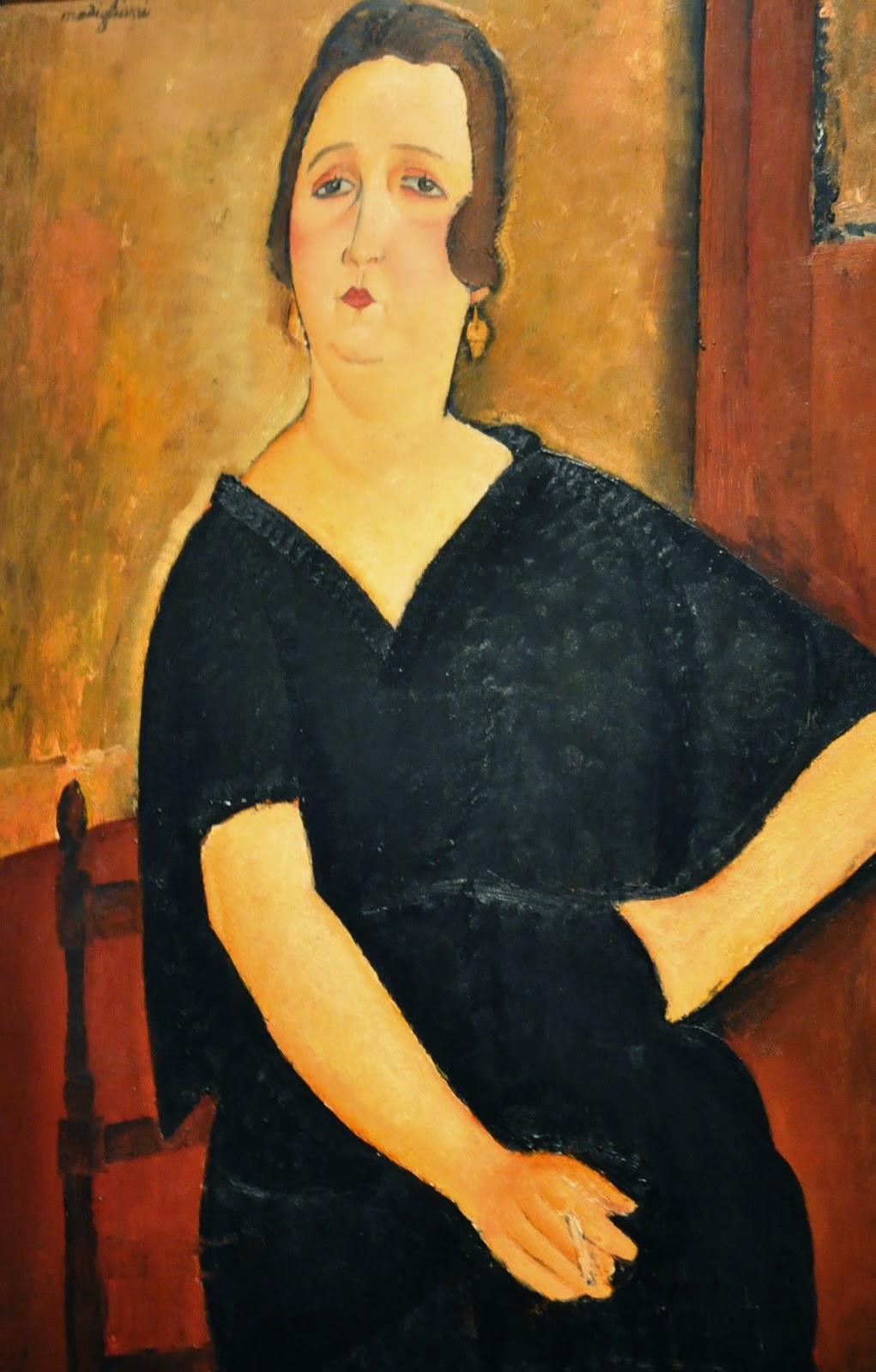
Madame Amédée-Woman with Cigarette (1918) 


It is very easy to recognize a work by Modigliani. The subjects of both his paintings and sculptures feature elongated faces, necks and features.

Chaim Soutine (1917)


Modigliani painted several portraits of his artist friends such as Maurice Utrillo, Pablo Picasso and Chaim Soutine.

Modigliani's use of drink and drugs contributed to his early death at age 35 in Paris of tubercular meningitis.

I will continue to show more of the spectacular Dale collection in my next blog post.

The National Gallery of Art is located on the National Mall between 3rd and 9th Streets along Constitution Avenue.
  • Admission is always FREE.
  • Open Monday-Saturday: 10 a.m. - 5 p.m.
  • Open Sunday: 11 a.m. - 6 p.m.
  • Closed on December 25 and January 1. 
All photos in this blog post were taken by me during my visit in September, 2013.

5.08.2012

IN THE GARDEN OF HÔTEL BIRON

The Hôtel Biron is the beautiful 18th-century mansion that houses the Musée Rodin in Paris.  The museum opened its doors in 1919, two years after Auguste Rodin died.  In 1753, the mansion, built between 1728 and 1730, was sold to Maréchal de Biron, who gave it its present name.   


In 1820, the Society of the Sacred Heart of Jesus became the owners of the property.  Its vocation was to educate the young girls of high society.  The mansion was stripped of all its embellishments and the gardens were allowed to grow wild.  The Society of the Sacred Heart of Jesus was dissolved in July, 1904, and the sisters were evicted. While awaiting a buyer, the Hôtel Biron was rented out to artists.  Its illustrious tenants included Isadora Duncan and Henri Matisse.  When the poet, Rainer Maria Rilke, who was Rodin's secretary, wrote to him about the mansion and abandoned gardens, Rodin rented four of the mansion's rooms in October of 1908 as his studio; by 1911, Rodin occupied the entire mansion.
Rodin loved the tangle of plants.  In 1908, Rodin first started placing some of his sculptures in the overgrown garden in addition to some of the ancient works of art from Egypt, Greece and Rome that he began collecting in the early 1890s. 

“Nature and Antiquity are the two great sources of life for an artist. In any event, Antiquity implies nature. It is its truth and its smile.”    Auguste Rodin (taken from www.musee-rodin.fr)


In 1910, the government of France purchased the property, initially to house the Department of Civil Buildings.  However, Rodin successfully negotiated with the French government; he would donate all his works to France under the stipulation that the French government keep the collection at Hôtel Biron:


“I give the State all my works in plaster, marble, bronze and stone, and my drawings, as well as the collection of antiquities that I had such pleasure in assembling for the education and training of artists and workers. And I ask the State to keep all these collections in the Hôtel Biron, which will be the Musée Rodin, reserving the right to reside there all my life.”   

Auguste Rodin - Correspondence of Rodin, volume III, 1908-1912, letter no. 103 to Paul Escudier, late 1909  (taken from www.musee-rodin.fr)

In 1916 the French legislature accepted Rodin's gift; the Musée Rodin opened its doors on August 4, 1919.

The first bronzes were placed in the gardens before World War I.   The large-scale Le Penseur (The Thinker) was transferred with its pedestal to the museum in 1922.  This image of a man lost in thought has become one of the most celebrated sculptures ever known.


The Thinker was eventually accompanied by an enlargement of Ugolino, set in the middle of the ornamental pool in 1927...


then by Les Bourgeois de Calais (Burgers of Calais) in 1937...


The statue of Balzac, an old bronze cast before 1936, was installed much later.  When the statue was originally unveiled, the crowd booed, a fitting tribute to the defiant writer.


In the 1993 restoration of the garden, which is spread over an area of three hectares, the landscape architect decided to keep the classical layout of the garden.  A large number of bronze sculptures are displayed throughout in the renovated gardens.   

Meditation with Arms


Fallen Caryatid with Urn


The Three Shades (the souls of the damned): a larger version of what sits on top of The Gates of Hell.


The Shade: a sculpture in which Rodin depicted most fully the lessons he had learned from the study of the works of Michelangelo during his visits to Italy.


Many visitors to Paris miss this wonderful museum dedicated to the works of one of the most talented sculptors in history.  They concentrate on Musée d'Orsay or the Musée du Louvre.  Even if you don't walk through the mansion, take a stroll through the gardens where many of Rodin's most important works are displayed among some of most beautiful flowers you will see in Paris.
Musée Rodin has partially reopened after being closed for the last three months.  A temporary presentation of the permanent collection called Masterpieces on the Move shows the most important works by Rodin and Camille Claudel in the east wing of the museum.  The west wing of the museum is closed until April, 2013.

Musée Rodin
79 Rue du Varenne, 75007 Paris 

Phone: +33 (0)1 44 18 61 10
Fax:     +33 (0)1 44 18 61 30 

Metro: Varenne (Line 13) or Invalides (Line 13, Line 8)
R.E.R:  Invalides (line C)
Bus:    69, 82, 87, 92

  • Admission fee is €6.00
  • Admission fee with temporary exhibit is €9.00
  • Admission fee for the gardens is €1.00
  • TIP: You should use your Paris Museum Pass.
  • Open Tuesday-Sunday 10:00-5:45 (last ticket sold 5:15).
  • Beginning April 3, 2012 Open Wednesday until 8:45. 
  • Closed Mondays.
  • Closed January 1, May 1 and December 25.

For more information visit the website: http://www.musee-rodin.fr/

NOTE: All photos in this post were taken by me during my visit in May, 2006.

4.11.2012

MUSEUM ON THE LAKE

The Milwaukee Art Museum is located right on the edge of Lake Michigan.


The museum buildings themselves are works of art, with two of the world's most famous architects designing different sections.

After World War II, Finnish architect Eliel Saarinen was commissioned to create an arts complex on the Lake Michigan shore, with a museum, performing arts center, and veterans’ memorial.  After he died in 1950, his son Eero Saarinen (who also designed the famous St. Louis Arch) took over the project.  The building’s design was later praised by Time magazine as “one of the country’s finest examples of modern architecture put to work for civic purposes.”  Years later, in planning for the Museum’s centennial birthday, another major expansion was proposed and accepted.  In 1994, based upon his international vision and skill as an engineer and architect, Spanish-born architect Santiago Calatrava was chosen to be the designer to carry the museum into the next millennium.

The Quadracci Pavilion, the first Calatrava-designed building to be completed in the United States, opened in 2001 to rave reviews.  From the photo below, you can see why.


It's probably not a coincidence that the lower section is designed in the shape of a ship...

What really makes this building a engineering masterpiece is the brise soleil which means sun breaker in French.  It's an architectural term refering to sun-shading techniques.  Here two wings, made up of 72 steel fins, span 217 feet at their widest point (imagine a 90-ton 747 jumbo jet)...
raise and lower depending on the time of day and the wind and weather conditions.  The "wings" also have two ultrasonic wind sensors which automatically close the wings if the wind speed reaches 23 mph or greater.

Here is a time-lapsed video showing how the wings raise and lower...


Inside the pavilion the glass-enclosed Windhover Hall, onto which the "wings" of the brise soleil rest, reminds me of a modern gothic cathedral complete with flying buttresses, a 90-foot vaulted ceiling and a nave shaped like a prow that extends into Lake Michigan.


Two arched promenades extend off of Windhover Hall...


The Baumgartner Galleria and the Schroeder Galleria are situated parallel to each other with an auditorium, museum store and galleries between the two promenades.  The Baumgartner Galleria faces east and provides views of Lake Michigan; the Schroeder Galleria faces west and looks out onto the Cudahy Gardens...


When the Quadracci Pavilion was built, the outside grounds were also redesigned.  The diagonally-divided squares of grass are themselves divided by 10-foot high hedgerows.  Straight down the middle of the grass squares is a long fountain with a solid 4-foot high water stream.  At each end are circular pools with fountains spraying as high as 35 feet in the air.


The gardens are named after the philanthropist who made them possible. The garden's geometric shapes fit perfectly with the design of the Quadracci Pavilion.

The Milwaukee Art Museum’s collection includes nearly 25,000 works from antiquity to the present.  In my next post, I'll show you some of my favorites.

Milwaukee Art Museum
Milwaukee, WI 53202

Phone: 414.224.3200
Fax: 414.271.7588

Email: mam@mam.org

For directions: click here.
  • Admission fee is $15.00 for adults
  • Admission fee is $12.00 for students, seniors and military.
  • Featured exhibitions are included in admission price.
  • Closed Mondays.
  • Closed Thanksgiving and Christmas Day.
  • Open Tuesday-Sunday 10:00-5:00
  • Open Thursday until 8:00.

3.17.2012

THE AMERICAN ARTISTS

It's not just about European painters...

I also love American painters and the Art Institute of Chicago has a superb collection of paintings by some of the most famous American painters.

The Art Institute has one of the most iconic paintings ever...

American Gothic (1930) by Grant Wood


Grant Wood adopted the precise realism of 15th-century northern European artists, but his native Iowa provided the artist with his subject matter. American Gothic depicts a farmer and his spinster daughter posing before their house, whose gabled window and tracery, in the American gothic style, inspired the painting's title. In fact, the models were the painter's sister and their dentist.

Here's another painting known throughout the art world...

Nighthawks (1942) by Edward Hopper

Edward Hopper said that Nighthawks was inspired by "a restaurant on New York's Greenwich Avenue where two streets meet," but the image, with its carefully constructed composition and lack of narrative, has a timeless quality that transcends its particular locale. One of the best-known images of 20th-century art, the painting depicts an all-night diner in which three customers, all lost in their own thoughts, have congregated. Fluorescent lights had just come into use in the early 1940s, and the all-night diner emits an eerie glow, like a beacon on the dark street corner. Hopper eliminated any reference to an entrance, and the viewer, drawn to the light, is shut out from the scene by a seamless wedge of glass. The four anonymous and uncommunicative night owls seem as separate and remote from the viewer as they are from one another.

George Wesley Bellows (1882-1925) actually taught at the Art Institute of Chicago in 1919.  Bellows' later works are the triumphs of American realism.

The Palisades (1909) by George Bellows


Love of Winter (1914) by George Bellows

Gifford Beal’s early work was extremely popular in both subject matter and in method: sparkling color and light carried by quick impressionist brushstrokes. Gradually, he moved away from the impressionist style and adopted a broadly realistic style.  Muted tones, strong, thick brushstrokes, and simplified compositions characterize his works such as this one:

The Puff of Smoke (1912) by Gifford Beal


During the 1890s the area surrounding his Greenwich, Connecticut home became John Henry Twachtman's main subject matter.  Influenced by Impressionism he was often compared with Claude Monet and James McNeill Whistler.  The painting below depicts Horseneck Brook on Twachtman's Connecticut property.  Like a Monet series, Twachtman painted the bridge six different times; each time its shape is slightly different in each work.

The White Bridge (1895) by John Henry Twachtman

Like George Wesley Bellows, Twachtman loved painting scenes of winter.

Icebound (1889) by John Henry Twachtman
 
John Singer Sargent was the most successive portrait painter of his era.  In the early 1880s Sargent regularly exhibited portraits at the Paris Salon, and these were mostly full-length portrayals of women.  Sargent's best portraits reveal the individuality and personality of the sitters; his most ardent admirers think he is matched in this only by Velázquez, who was one of Sargent's great influences.

Mrs. George Swinton (1897) by John Singer Sargent

The Fountain, Villa Torlonia, Frascati, Italy (1907) by John Singer Sargent

I also like the colors and the subjects in the painting below.  John Sloan often painted the leisure activities of working class women and the social changes of the 20th century.

Renganeschi's Saturday Night (1912) by John Sloan

This painting by William Glackens is one of my favorites painting in the Art Institute. I love the use of such vivid colors. You can see how Glackens became influenced by Renoir in this painting. It really reminds me of Renoir's famous Bal du Moulin de la Galette. Glackens was known in some circles as the "American Renoir".

Mouquin's (1905) by William Glackens


Of course I can't forget the female American painters.  In the early part of the 20th century, Elizabeth Sparhawk-Jones was a well-known, heralded female painter; the New York Times anointed her “the find of the year” in 1908.  However, due to her struggles with mental illness, she disappeared from the art scene.  Twenty years later she re-emerged with an original style that sparked a second success as a painter.  However, I love this early work of hers depicting the female employees assisting customers in the new concept of the "department store".

Shoe Shop (1911) by Elizabeth Sparhawk-Jones


And finally there is the most famous female American Impressionist painter, Mary Cassatt.  Mary Cassatt first became acquainted with Edgar Degas and eventually participated in exhibitions with other famous French Impressionists.

On a Balcony (1878) by Mary Cassatt

Many of Cassatt's works emphasized the bond between Mother and Child...

The Child's Bath (1893) by Mary Cassatt

Summertime (1894) by Mary Cassatt

I have shown you just a handful of the works by American painters that hang in the Art Institute of Chicago.  Over 1,000 paintings and sculptures from the 18th century to the 1950s are part of the permanent collection.  The paintings in this post along with the paintings I showed you in the previous two posts proves the Art Institute of Chicago is a world-class art museum.
  • Admission for adults is $18.00**
  • Admission for Students and Seniors is $12.00.
  • Closed Thanksgiving, Christmas, and New Year’s days.
  • Open Monday, Tuesday, Wednesday 10:30-5:00.
  • Open Thursday 10:30-8:00.
  • Open Friday, Saturday, Sunday 10:30-5:00.
  • Free Family Wednesdays: Admission to the Art Institute of Chicago is free to Illinois residents the first and second Wednesday of every month. 
** Chicago residents receive a $2 discount on admission in recognition of the significant support given to the museum through local property taxes. A valid photo ID with a resident address is required.

For more information, visit: http://www.artic.edu/.

2.26.2012

AN APPRECIATION OF NEW ART

My love of art first began back in 2002 during my first visit to the Art Institute of Chicago for the exhibition: Van Gogh and Gauguin: Studio of the South.  I not only discovered the genius of van Gogh...

The Poet's Garden (1888)


The Drinkers (1890)


and Gauguin...

Polynesian Women with Children (1901)

but because of the extensive number of French Impressionist paintings in the museum's permanent collection, I was introduced to Monet...

Sandvika, Norway (1895)


Poppy Field: Giverny (1890-1891)


Cézanne...

The Bathers (1899)

The beauty of Renoir...

Two Sisters: On the Terrace (1881)


Near the Lake (1879)


and Pissarro...

Rabbit Warren at Pontoise, Snow (1879)


In 2006 I traveled to Paris and visited the Museé d'Orsay and the Museé Marmottan to see their wonderful collections of French Impressionist paintings.  However, during a visit to the just-reopened Museé de l'Orangerie, I discovered another painter whose paintings I really like: Modigliani and during a visit to the Art Institute, I discovered one of his wonderful paintings...

Jacques and Berthe Lipchitz (1916)


In 2008, I traveled to Rome to experience the food and test my, at that time, limited Italian vocabulary.  And, of course, there is the fabulous Italian art, so much of which is free to see because it is housed in many churches of Rome.  There are at least three churches where you can see masterpieces of Caravaggio...just walk right into the church and there they are! 

Unfortunately the Art Institute of Chicago has no Caravaggio pieces in its permanent collection.  However, during my most recent visit to the museum in late 2009 (I can't believe I haven't been there for over two years!!), one of his masterpieces was on loan from the National Gallery of Art in London.

Oops...didn't see that "No Photos" sign until after I took the picture!  What a masterpiece!

The Supper at Emmaus (1601):


"This is an extremely rare opportunity to view firsthand one of the most highly regarded paintings by one of the most influential Western artists of all time. There are very few paintings by Caravaggio in American museums, and none that can rival this painting in its immediate impact. The Supper at Emmaus, painted in 1601 for a Roman nobleman, comes from the outset of a new, mature phase of the master’s career in which he treated great religious subjects with uncompromising realism, while at the same time employing his trademark contrasts of light and dark to great dramatic effect. In this revelatory image, two of Christ’s disciples have just recognized that the stranger at their table is none other than Christ himself, reappearing to them after his death and Resurrection."

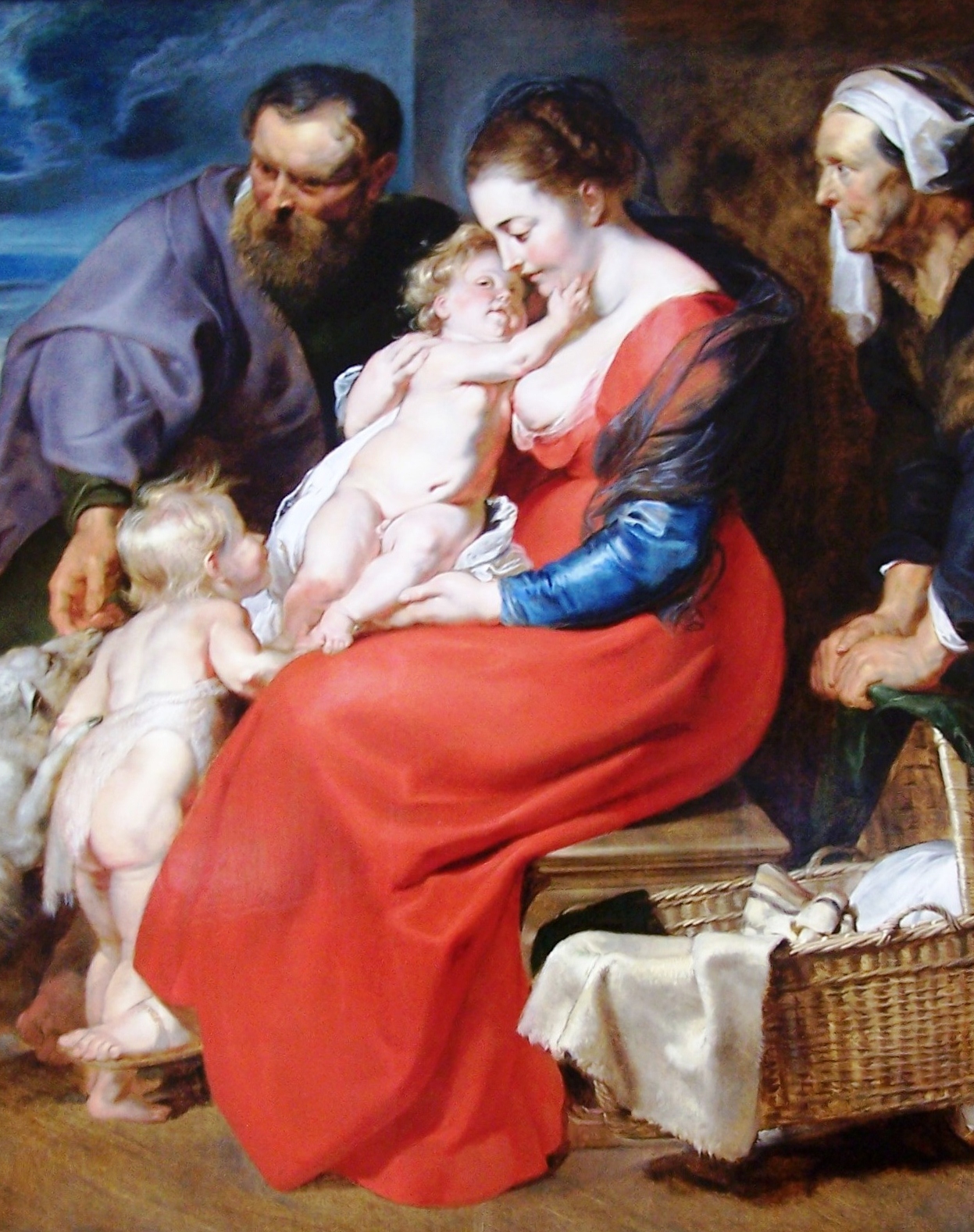
In 2010, I was finally able to travel to Amsterdam to visit both the Van Gogh Museum and the extensive collection of van Gogh paintings at the Kröller Müller Museum.  But I actually enjoyed seeing the Flemish masterpieces more than van Gogh's paintings and came to appreciate them more.  The Art Institute has several magnificent works by Peter Paul Rubens...

The Holy Family with Saints Elizabeth and John the Baptist (1615)


The Capture of Samson (1609/1610)

Another wonderful example of a Flemish masterpiece is this portrait by Frans Pourbus the Younger.  The frame is a masterpiece, too...

Marie de' Medici (1616)


From my initial visit to the Art Institute of Chicago to each of my European trips, each time I have discovered new artists and their works.  How fortunate I am that my hometown, world-class art museum has so many examples of their work!

But it's not just the works of the European painters that I admire.  On my next post I'm going to introduce you to some brilliant American painters whose works are part of the permanent collection of the Art Institute of Chicago.
  • Admission for adults is $18.00**
  • Admission for Students and Seniors is $12.00
  • Closed Thanksgiving, Christmas, and New Year’s days.
  • Open Monday, Tuesday, Wednesday 10:30-5:00.
  • Open Thursday 10:30-8:00.
  • Open Friday, Saturday, Sunday 10:30-5:00.
  • Free Family Wednesdays: Admission to the Art Institute of Chicago is free to Illinois residents the first and second Wednesday of every month.
** Chicago residents receive a $2 discount on admission in recognition of the significant support given to the museum through local property taxes. A valid photo ID with a resident address is required.

For more information, visit: http://www.artic.edu/.