Showing posts with label Van Gogh. Show all posts

4.28.2016

THE VAN GOGH'S BEDROOMS EXHIBITION

The current exhibition at the Art Institute of Chicago of Van Gogh's Bedrooms just might be the most visited exhibition held there since the hugely popular Monet exhibition in 1995.

I couldn't believe the extremely long line outside the museum waiting to get in.  We were able to bypass this line because I had pre-purchased our tickets, but once inside we were not able to avoid the huge line to get into the exhibition.  I have been to several exhibitions at the Art Institute, but I have never seen such a crowd before. NOTE: we were there on a Saturday; I'm sure weekend days are much less crowded.

We finally entered the exhibition, and were pleasantly surprised non-flash photography was allowed. This must be a new policy. At every other special exhibition I have been to photography wasn't allowed basically because the host museum has the other paintings lent to them for the exhibition and they can't be responsible for them. 

Here are my highlights of the exhibition:

Parisian Novels (1887) 
Private Collection

This painting was the highlight! As it is from someone's private collection I had never seen even a photograph of it. The pink, blue and yellow color palette makes it so recognizable as a Van Gogh masterpiece. It is just a gorgeous painting.

Hospital at St. Rémy (1889)
Hammer Museum, Los Angeles 

This painting is one of two large landscapes showing the trees in the garden and the asylum façade behind them. Consciously or not, Van Gogh used the same color palette for this building as he did in his famous Yellow House (yellow building, green shutters, red roof).


Corner of the Asylum and the Garden with Heavy Sawed-Off Tree (1889)
Museum Folkwang, Essen, Germany


Van Gogh used "...a combination of red ocher, of green saddened with grey, of black lines that define the outlines", a combination he believed emphasized the emotional impact of this painting. Van Gogh used his time at the asylum to advance and refine the symbolic power of his painting.


Entrance to the Public Gardens in Arles (1888)
Phillips Collection, Washington DC


This painting depicts the view of the public garden located across the street from Van Gogh's yellow house in Arles.

Gauguin's Chair (1888)
Van Gogh Museum, Amsterdam


Since photography is not allowed at the Van Gogh Museum in Amsterdam, I didn't have the opportunity to photograph this masterpiece when I visited in 2010.

Van Gogh's Chair (1888)
National Gallery of Art, London, England


Yet another Van Gogh painting I had not seen before. This is the companion painting to the above painting. Van Gogh painted both during the few weeks he and Gauguin lived and painted together in Arles.

Houses at  Auvers (1890)
Toledo Museum of Art

I remember seeing this painting during my visit to the Toledo Museum of Art. Working in a hamlet in the western part of Auvers, Van Gogh painted this small cluster of dwellings nestled among the walled gardens and trees.  He varied his brushstrokes in order to call attention to difference between the tiled roof and the other thatched roofs.

View of the Asylum with a Pine Tree
Musée d'Orsay, Paris


I don't recall seeing this painting during my visit to the Musée d'Orsay several years ago.  It is one of dozens of works Van Gogh painted while sitting in the gardens of the asylum in St. Remy.

Eugene Boch
Musée d'Orsay, Paris


Van Gogh wanted to decorate the walls of the Yellow House with portraits. Boch was a Belgian impressionist painter and one of the few friends Van Gogh met while in Arles.

Self-Portrait (1889)
National Gallery of Art, Washington DC


Van Gogh painted this self-portrait while in the asylum. None of the other patients were willing to sit as a model for him. He is posed in this way because his left ear was disfigured from his self-mutilation the previous December.

Then, of course, there were the three "Bedrooms":

The Bedroom (October 16-17, 1888)
Van Gogh Museum, Amsterdam


Van Gogh painted this first version to decorate the Yellow House in anticipation of the arrival of Gauguin to Arles. Note that the two portraits I posted above are included in this painting on the right wall above the bed.

The Bedroom (September 5, 1889)
Art Institute of Chicago

The second version was painted while Vincent was a patient at the asylum in St. Rémy.  The first painting had been slightly damaged in a flood in Arles; Van Gogh's brother, Theo, thought Vincent should make another copy before repairs were made to first painting in case something bad occurred. Note how Van Gogh changed the portraits hanging above the bed.

The Bedroom (September 28, 1889)
Musée d'Orsay, Paris


In a letter to his brother Theo, Vincent explained what had inspired him to paint these pictures: he wanted to express the tranquility, and bring out the simplicity of his bedroom using the symbolism of colors. The bright colours were meant to express absolute ‘repose’ or ‘sleep’. Thus, he described: "the pale, lilac walls, the uneven, faded red of the floor, the chrome-yellow chairs and bed, the pillows and sheet in very pale lime green, the blood-red blanket, the orange-colored wash stand, the blue wash basin, and the green window", stating "I wanted to express absolute repose with these different colors".  Van Gogh's three versions of this composition are the only record he made of the interior of the Yellow House.

Van Gogh's Bedrooms is on view at the Art Institute of Chicago until May 10. For more information, click here.


Thank you for visiting.

A Great Europe Trip Planner


All photos were taken by me at the Art Institute of Chicago. Unauthorized use is prohibited.


4.23.2015

EARLY WORKS AT THE "OTHER" VAN GOGH MUSEUM

Do you know about the "other" Van Gogh museum near Amsterdam?

Helene Kröller-Müller, German by birth but married to successful Dutch businessman Anton Kröller, amassed a collection of over 11,500 art objects between 1907 and 1922. This makes her collection one of the largest private collections of the 20th century. One of her favorite artists was Vincent van Gogh...she was an early admirer of his paintings when his work were not very well known. She became the owner of more van Gogh paintings than anyone other than the van Gogh family itself, nearly 100 paintings and over 180 drawings. 

The Kröller-Müller Museum is about an hour's train ride from Amsterdam, located in the town of Otterlo in the middle of the Hoge Veluwe National Park and is home to some of van Gogh's most famous and beloved masterpieces.  Let's start with some of his early works when he was still painting with the darker palette:

Loom with Weaver (1884) by Vincent van Gogh at the Kröller-Müller Museum


Still Life with Clogs (1881) by Vincent van Gogh at the Kröller-Müller Museum


Oxcart (1884) by Vincent van Gogh at the Kröller-Müller Museum


Head of a Man with a Pipe (1884) by Vincent van Gogh at the Kröller-Müller Museum


Lane of Poplars at Sunset (1884) by Vincent van Gogh at the Kröller-Müller Museum
Peasant Women Digging Up Potatoes (1885) by Vincent van Gogh at the Kröller-Müller Museum


Autumn Landscape (1885) by Vincent van Gogh at the Kröller-Müller Museum


Moulin de la Galette (1886) by Vincent van Gogh at the Kröller-Müller Museum
Thank you for visiting,

A Great Europe Trip Planner 

All photos were taken by me during my visit to the museum. 

The museum is closed Mondays and January 1.

The museum is open Tuesday through Sunday and national holidays* from 10.00 to 17.00.

* Easter, Pentecost, Christmas, King’s Day (April 27), Liberation Day (May 5).

The sculpture garden is open until 16.30.

1.01.2013

VINCENT AT THE ORSAY

Amazing as it is, Vincent van Gogh sold only one painting during his lifetime.  One painting!  Now Vincent van Gogh is one of the most beloved painters.  One of his paintings can sell for tens of millions of dollars. 

The Musée d'Orsay's permanent collection contains some of the most famous and beautiful works by Vincent van Gogh.


Van Gogh often used himself as a model; he produced over 43 self-portraits, paintings or drawings in ten years.
 
La Chambre de Van Gogh à Arles (1889)


I have seen all three versions of this painting: here at the Musée d'Orsay, at the Art Institute of Chicago and in the Van Gogh Museum in Amsterdam.

L'Arlésienne (1888)
Madame Ginoux ran the Café de la Gare in Arles.  Van Gogh, inspired by the sketches of her by his friend, Paul Gauguin, ended up painting six different paintings of Madame Ginoux.

Eugène Boch (1888)


Eugène Boch was a Belgian painter and a member of the family of fine china manufacturers, the Boch of Villeroy & Boch.  Eugène often exchanged works with other artists, as he did with van Gogh.  Upon his death in 1941, Boch bequeathed this painting, which he received in accordance to the last will of Vincent and Theo, to the Louvre.

Le Docteur Paul Gachet (1890)


After he moved to Auvers-sur-Oise, Vincent became a patient of Dr. Gachet on the advice of his brother Theo. The portrait of the doctor was painted during van Gogh's particularly intense creative phase. The doctor is portrayed in a melancholy pose reflecting, as Van Gogh wrote, "the desolate expression of our time". The only touch of hope in the portrait brushed in cold colors is the foxglove which brings a little comfort and relief through its curative properties. 

La sieste: d'après Millet (1890)


The siesta was painted while Van Gogh was in the mental hospital in Saint-Rémy de Provence. The composition is taken from a drawing by French painter Jean-François Millet. Van Gogh often copied the works of Millet.
 
La Salle de Danse à Arles (1888)


This painting shows an evening at the Folies-Arlésiennes, a dance hall on Boulevard des Lices in Arles. A reference to Japanese art is evident in the strange, decorative foreground where the curves of the hair are dominant.

In May 1890, van Gogh left the clinic in Saint-Rémy to be closer to his brother, Theo and Dr. Gachet in the town of Auvers-sur-Oise.  During these 70 days van Gogh painted nearly 70 paintings, some of his most beautiful works.
Mademoiselle Gachet dans son jardin à Auvers-sur-Oise (1890)

Chaumes de Cordeville à Auvers-sur-Oise (1890)

L'Église d'Auvers-sur-Oise, Vue du Chevet (1890)


For more information visit: http://www.musee-orsay.fr.

To get to the Musée d'Orsay, use:
Metro: Line 12 to Solférino
RER: Line C to Musée d'Orsay
Bus: Lines 24, 63, 68, 69, 73, 83, 84, 94


  • Regular admission is €9.00.
  • FREE with your Paris Museum Pass.
  • There may be a charge for special exhibitions.
  • Closed Mondays.
  • Closed January 1, May 1, Christmas Day.
  • Open 9:30-6:00 on Tuesday-Thursday.
  • Open 9:30-9:45 on Thursday

NOTE: All photos of the paintings in this blog post were taken by me on my visit to the Musée d'Orsay in May, 2006. Unfortunately photography is no longer allowed at the museum.

2.26.2012

AN APPRECIATION OF NEW ART

My love of art first began back in 2002 during my first visit to the Art Institute of Chicago for the exhibition: Van Gogh and Gauguin: Studio of the South.  I not only discovered the genius of van Gogh...

The Poet's Garden (1888)


The Drinkers (1890)


and Gauguin...

Polynesian Women with Children (1901)

but because of the extensive number of French Impressionist paintings in the museum's permanent collection, I was introduced to Monet...

Sandvika, Norway (1895)


Poppy Field: Giverny (1890-1891)


Cézanne...

The Bathers (1899)

The beauty of Renoir...

Two Sisters: On the Terrace (1881)


Near the Lake (1879)


and Pissarro...

Rabbit Warren at Pontoise, Snow (1879)


In 2006 I traveled to Paris and visited the Museé d'Orsay and the Museé Marmottan to see their wonderful collections of French Impressionist paintings.  However, during a visit to the just-reopened Museé de l'Orangerie, I discovered another painter whose paintings I really like: Modigliani and during a visit to the Art Institute, I discovered one of his wonderful paintings...

Jacques and Berthe Lipchitz (1916)


In 2008, I traveled to Rome to experience the food and test my, at that time, limited Italian vocabulary.  And, of course, there is the fabulous Italian art, so much of which is free to see because it is housed in many churches of Rome.  There are at least three churches where you can see masterpieces of Caravaggio...just walk right into the church and there they are! 

Unfortunately the Art Institute of Chicago has no Caravaggio pieces in its permanent collection.  However, during my most recent visit to the museum in late 2009 (I can't believe I haven't been there for over two years!!), one of his masterpieces was on loan from the National Gallery of Art in London.

Oops...didn't see that "No Photos" sign until after I took the picture!  What a masterpiece!

The Supper at Emmaus (1601):


"This is an extremely rare opportunity to view firsthand one of the most highly regarded paintings by one of the most influential Western artists of all time. There are very few paintings by Caravaggio in American museums, and none that can rival this painting in its immediate impact. The Supper at Emmaus, painted in 1601 for a Roman nobleman, comes from the outset of a new, mature phase of the master’s career in which he treated great religious subjects with uncompromising realism, while at the same time employing his trademark contrasts of light and dark to great dramatic effect. In this revelatory image, two of Christ’s disciples have just recognized that the stranger at their table is none other than Christ himself, reappearing to them after his death and Resurrection."

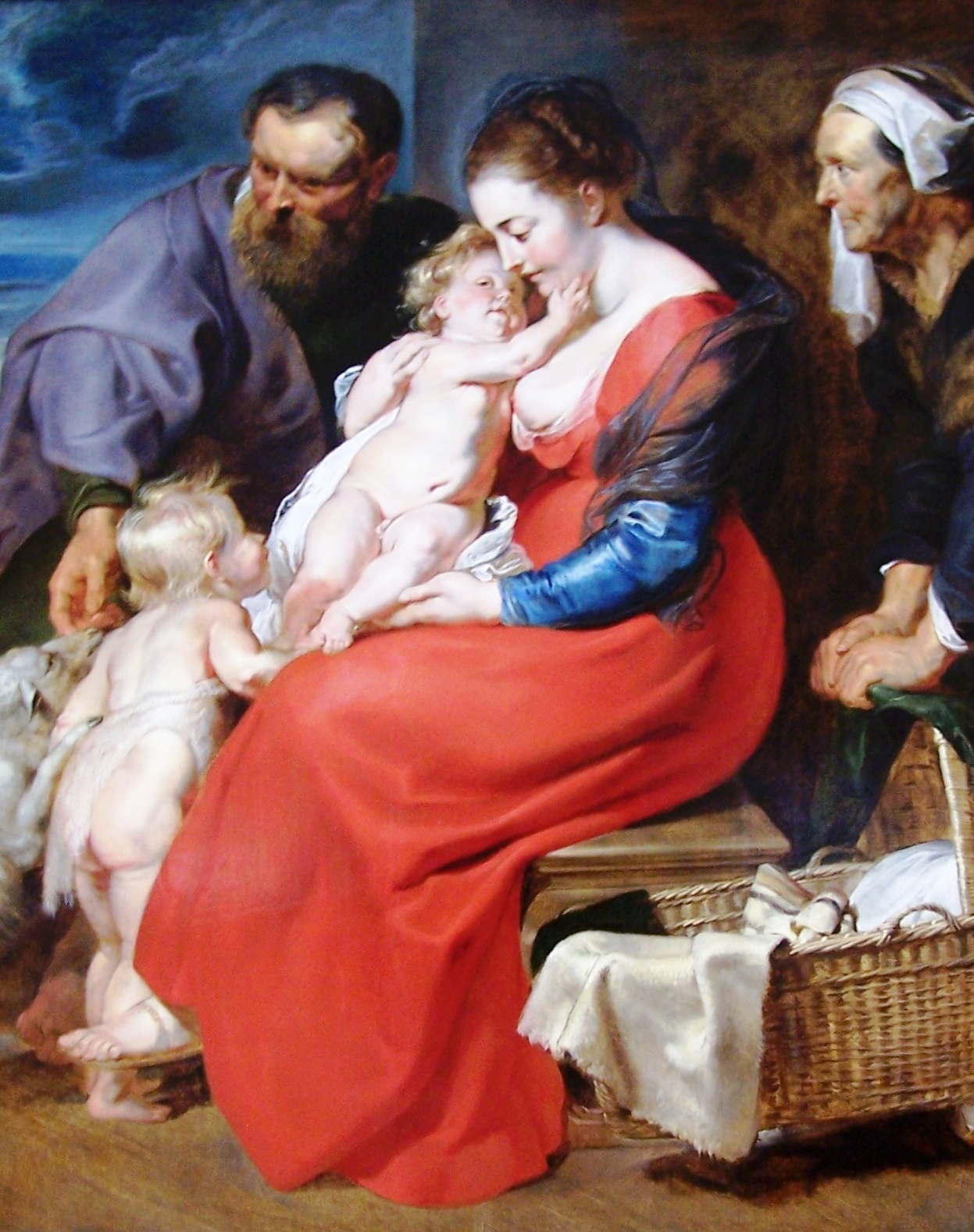
In 2010, I was finally able to travel to Amsterdam to visit both the Van Gogh Museum and the extensive collection of van Gogh paintings at the Kröller Müller Museum.  But I actually enjoyed seeing the Flemish masterpieces more than van Gogh's paintings and came to appreciate them more.  The Art Institute has several magnificent works by Peter Paul Rubens...

The Holy Family with Saints Elizabeth and John the Baptist (1615)


The Capture of Samson (1609/1610)

Another wonderful example of a Flemish masterpiece is this portrait by Frans Pourbus the Younger.  The frame is a masterpiece, too...

Marie de' Medici (1616)


From my initial visit to the Art Institute of Chicago to each of my European trips, each time I have discovered new artists and their works.  How fortunate I am that my hometown, world-class art museum has so many examples of their work!

But it's not just the works of the European painters that I admire.  On my next post I'm going to introduce you to some brilliant American painters whose works are part of the permanent collection of the Art Institute of Chicago.
  • Admission for adults is $18.00**
  • Admission for Students and Seniors is $12.00
  • Closed Thanksgiving, Christmas, and New Year’s days.
  • Open Monday, Tuesday, Wednesday 10:30-5:00.
  • Open Thursday 10:30-8:00.
  • Open Friday, Saturday, Sunday 10:30-5:00.
  • Free Family Wednesdays: Admission to the Art Institute of Chicago is free to Illinois residents the first and second Wednesday of every month.
** Chicago residents receive a $2 discount on admission in recognition of the significant support given to the museum through local property taxes. A valid photo ID with a resident address is required.

For more information, visit: http://www.artic.edu/.