I've written several posts about the world-class museums I've been fortunate to visit in my travels in Europe, but you know what? I've got a world-class art museum right in my own backyard! The Art Institute of Chicago.
The Art Institute of Chicago has one of the most renowned collections of paintings in the world. But it's not just the collection inside the building that is famous. The building that houses the collection is just as famous. The exterior of the Art Institute is one of the most photographed buildings in Chicago, and the two huge lions that greet visitors at the entrance attract as much attention today as they did more than a century ago.
They get decorated with wreaths every Christmas...

And they get into the spirit of special sports occasions such as when the Blackhawks won the Stanley Cup Championship in 2010.

But of course, it's the art collection everyone comes to see when they visit the museum. Some of my most favorite paintings are part of its permanent collection:
Young Girl with Hat (1892) by Berthe Morisot

This is my absolute favorite painting in any museum, and Berthe Morisot is my favorite painter. She was a rare female French Impressionist, painting at the same time as her colleagues Monet, Degas, Sisley, Renoir and Édouard Manet with whom she was romantically involved. However, she married Eugene Manet, Édouard's brother. Other excellent works by her are:
The Garden (1882) by Berthe Morisot

Woman at her Toilette (1875) by Berthe Morisot

One of the last visits I made to the museum I discovered this masterpiece which I had not seen on display previously:
Auvers, Panoramic View (1873/1875) by Paul Cézanne

Édouard Vuillard is one of my favorite painters. The Art Institute has several wonderful examples of his work:
Annette Roussel with a Broken Chair (1900) by Édouard Vuillard


Vuillard's Room at the Château des Clayes (1932) by Édouard Vuillard

Madame Arthur Fontaine in a Pink Shawl (1904) by Édouard Vuillard

Woman seated on a Sofa (1906) by Édouard Vuillard

Vuillard was a member of a post-Impressionist group called The Nabis, a group of painters whose works I enjoy. Nabi means prophet in Hebrew and in Arabic. The rebellious group of young student artists came together in the fall of 1888, and like many of the Impressionists and post-Impressionists, they were inspired by the broad planes of unmediated color, thick outlines, and bold patterns. Another fantastic example is:
The White Tablecloth (1926) by Pierre Bonnard

Another group of Post-Impressionist painters I like are the Fauvists (fauve means wild beast in French) also because of their use of bright, intense colors. Excellent examples (such vivid colors!) in the Art Institute collection include:
Antwerp (1906) by Georges Braque

Landscape at L'Estaque (1906) by Georges Braque

Another one of my favorite paintings is by the Dutch painter, Piet Mondrian. There is just something about the symmetry with the simple horizontal and vertical lines and colors and reflection in this painting that I find mesmerizing.
Farm near Duivendrecht (1916) by Piet Mondrain

Continuing on the Dutch theme and remembering my recent trip to the Netherlands, on my most recent visit to the Art Institute, I sought out any Dutch Masters paintings in the collection. Jan Steen was one of the original 17th century Dutch Golden Age painters. He was known for painting scenes of daily life. Many of the scenes he portrayed are lively to the point of chaos, so much so that a Jan Steen household, meaning a messy scene, became a Dutch proverb.
The Family Concert (1666) by Jan Steen

You can't speak about Dutch painters without mentioning Rembrandt. Throughout his career, Rembrandt painted powerful studies of single figures, conveying character through dramatic costume and lighting.
Old Man with a Gold Chain (1631) by Rembrandt Harmensz van Rijn

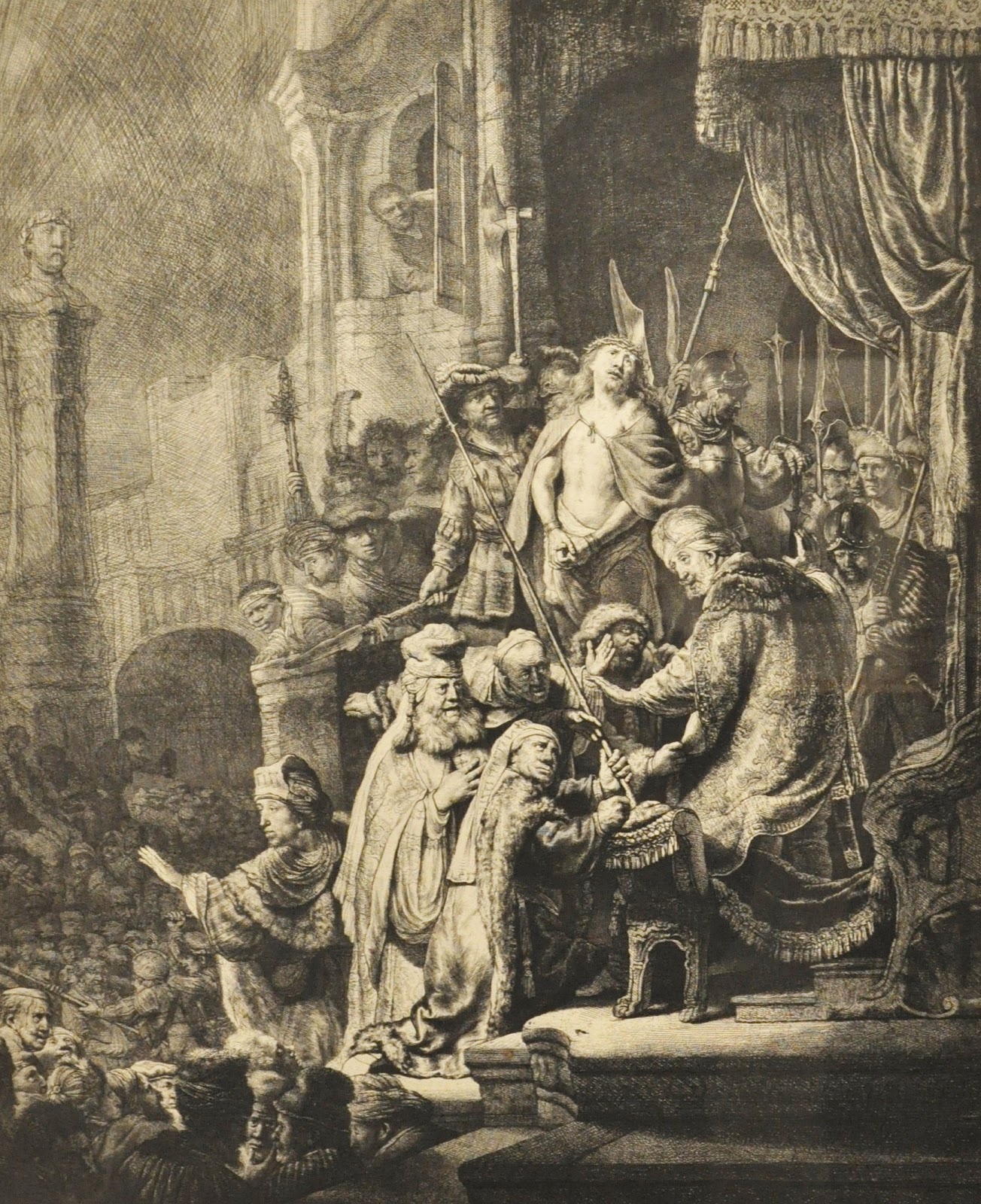
The museum has dozens of wonderful etchings by Rembrandt. This print exemplifies the popular depiction of the Passion of Christ which often combined multiple part of the New Testament story into one overwhelming scene:
Christ Before Pilate: Large Plate (1636) by Rembrandt Harmensz van Rijn
Jan Uytenbogaert, “The Goldweigher” (1639) by Rembrandt Harmensz van Rijn

Other painters discovered on my recent Netherlands/Belgium trip were the Flemish masters, one painter being Hans Memling. Imagine my delight in finding this diptych in the Art Institute collection. Separated for many years, the two images were reunited in 1953. Fortunately, the image on the left is still in wonderful condition, even after 525 years! Unfortunately, the original matching image on the right side is in poor condition. The image shown here on the right side is actually the back side of the original painting, Portrait of a Man in Prayer.
Virgin and Child (1485) by Hans Memling
St. Anthony of Padua (1485) by Hans Memling

Photo of the original diptych showing Portrait of a Man in Prayer.

And of course, there are the German Expressionist paintings, my love of which I wrote about in my last post. There are some excellent German Expressionist paintings in the Art Institute's permanent collection.
Despite being raised in a country that discouraged women from careers in art, Gabriele Münter became a founding member of one of the most influential early 20th-century modernist movements: German expressionism. In 1911 Gabriele Münter, along with Franz Marc and her lover, Wassily Kandinsky, founded the Der Blaue Reiter group, an important expressionist organization.
Still Life with Queen (1912) by Gabriele Münter

The Bewitched Mill (1913) by Franz Marc

Red-Haired Girl (1919) by Emil Nolde

Speaking of color: You can't forget this artist:
Interior at Nice (1919 or 1920) by Henri Matisse

Women before an Aquarium (1921-1923) by Henri Matisse

These are just a few of my favorite paintings located in the Art Institute of Chicago. All photos in this post were taken by me at various visits to the museum.
In my next post I'll continue showing many more of my favorite paintings from several different genres.
- Admission for adults is $18.00**
- Admission for Students and Seniors is $12.00
- The museum is closed Thanksgiving, Christmas, and New Year’s days.
- Open Monday, Tuesday, Wednesday 10:30-5:00.
- Open Thursday 10:30-8:00.
- Open Friday, Saturday, Sunday 10:30-5:00.
- Free Family Wednesdays: Admission to the Art Institute of Chicago is free to Illinois residents the first and second Wednesday of every month.
** Chicago residents receive a $2 discount on admission in recognition of the significant support given to the museum through local property taxes. A valid photo ID with a resident address is required.
For more information, visit: http://www.artic.edu


