Showing posts with label Amsterdam. Show all posts

8.24.2015

WATERLOGUE WISTFULNESS

There is something exciting about seeing a real Dutch windmill for the first time. When I visited Amsterdam a few years ago, I was thrilled to see them dotted along the countryside during train excursions to Delft, the Mauritshuis and the Kröller-Müller Museum. At the Keukenhof Gardens there is a windmill that visitors can actually go inside. Walking up a flight of stairs visitors can see how the giant blades rotate. The photo below shows that windmill along with some of the beautiful trees that were in bloom during my visit.


If you are interested in purchasing variations of this print, please visit my Travels in Watercolor blog by clicking here.

Thank you for visiting,

A Great Europe Trip Planner 

Photo taken by me during my visit to the Keukenhof Gardens in May, 2010.
Waterlogue image created by me.
Unauthorized use is prohibited.

4.23.2015

EARLY WORKS AT THE "OTHER" VAN GOGH MUSEUM

Do you know about the "other" Van Gogh museum near Amsterdam?

Helene Kröller-Müller, German by birth but married to successful Dutch businessman Anton Kröller, amassed a collection of over 11,500 art objects between 1907 and 1922. This makes her collection one of the largest private collections of the 20th century. One of her favorite artists was Vincent van Gogh...she was an early admirer of his paintings when his work were not very well known. She became the owner of more van Gogh paintings than anyone other than the van Gogh family itself, nearly 100 paintings and over 180 drawings. 

The Kröller-Müller Museum is about an hour's train ride from Amsterdam, located in the town of Otterlo in the middle of the Hoge Veluwe National Park and is home to some of van Gogh's most famous and beloved masterpieces.  Let's start with some of his early works when he was still painting with the darker palette:

Loom with Weaver (1884) by Vincent van Gogh at the Kröller-Müller Museum


Still Life with Clogs (1881) by Vincent van Gogh at the Kröller-Müller Museum


Oxcart (1884) by Vincent van Gogh at the Kröller-Müller Museum


Head of a Man with a Pipe (1884) by Vincent van Gogh at the Kröller-Müller Museum


Lane of Poplars at Sunset (1884) by Vincent van Gogh at the Kröller-Müller Museum
Peasant Women Digging Up Potatoes (1885) by Vincent van Gogh at the Kröller-Müller Museum


Autumn Landscape (1885) by Vincent van Gogh at the Kröller-Müller Museum


Moulin de la Galette (1886) by Vincent van Gogh at the Kröller-Müller Museum
Thank you for visiting,

A Great Europe Trip Planner 

All photos were taken by me during my visit to the museum. 

The museum is closed Mondays and January 1.

The museum is open Tuesday through Sunday and national holidays* from 10.00 to 17.00.

* Easter, Pentecost, Christmas, King’s Day (April 27), Liberation Day (May 5).

The sculpture garden is open until 16.30.

2.13.2011

REMBRANDTHUIS


You are now entering the house in which the painter Rembrandt Harmenszoon van Rijn lived and worked from 1639 to 1658.  Rembrandt bought this large and imposing house for 13,000 guilders, an immense sum for the time.  He was not concerned by such high expenditure.  He was a celebrated artist and his earnings were good.  This is where Rembrandt and his wife, Saskia, spent their happiest and Rembrandt's most successful years, a time when pupils and commissions came to him in a steady stream. 

He used the lower floor for living quarters.  Visitors came into Rembrandt’s house through this imposing entrance hall:
They could sit on one of the chairs ranged around the walls. The walls were covered with paintings by Rembrandt himself and by other masters. They were for sale.

Rembrandt carried on his art dealing business in the elegant Anteroom:


He received his clients with a glass of chilled wine from a marble wine cooler. The walls were covered with paintings from which the client could choose. Rembrandt sold his own works and works by his many pupils. He also dealt in paintings by other masters. This was common practice among artists at this time. Rembrandt had Flemish and Italian works in stock, but most of the paintings were by Dutch masters.

The Salon was Rembrandt’s living room and bedroom:


Paintings hung on the walls of this high-ceilinged room, among them biblical scenes by Rembrandt and works by artists who were close to his heart, including Pieter Lastman, Jan Lievens and Hercules Segers. Rembrandt slept in a box bed by the door.

This room, the largest in the house, was Rembrandt’s studio:


It was in this room that he painted his masterpieces between 1639 and 1658. The room faces north. Exactly the right, constant light enters through the windows. The position of Rembrandt’s easel is shown in one of his drawings. Assistants made Rembrandt’s paint and prepared his canvases. Artists’ paraphernalia lay scattered all over the studio:


Weapons and plaster casts on shelves around the walls were used by Rembrandt and his pupils as models. 

This room is where Rembrandt kept his collection of objets d'art and rarities:


Arranged on shelves around the walls were innumerable rare objects, many of which came from distant lands. Rembrandt collected seashells, corals, dried animals and exotic weapons. There were busts of Roman emperors, Venetian glassware and a terrestrial and a celestial globe. The room was a world of art and discovery in miniature. Rembrandt’s ‘art books’ were his most prized possession. He kept some 8000 drawings and prints by famous artists in these albums.

The kitchen was the most comfortable room in Rembrandt’s house:


The fire was kept burning most of the time. This is where the cooking was done and where the household ate. The maid slept in the box bed. 

After a succession of subsequent owners, the house was bought by the city of Amsterdam in 1906 and restored as how it was in Rembrandt's time.  Queen Wilhelmina officially opened the Museum het Rembrandthuis on June 10, 1911.  Members of the museum’s first board of governors decided to assemble a fine collection of Rembrandt’s etchings and drawings including landscapes, nude studies, religious and crowd scenes and sketches by Rembrandt:

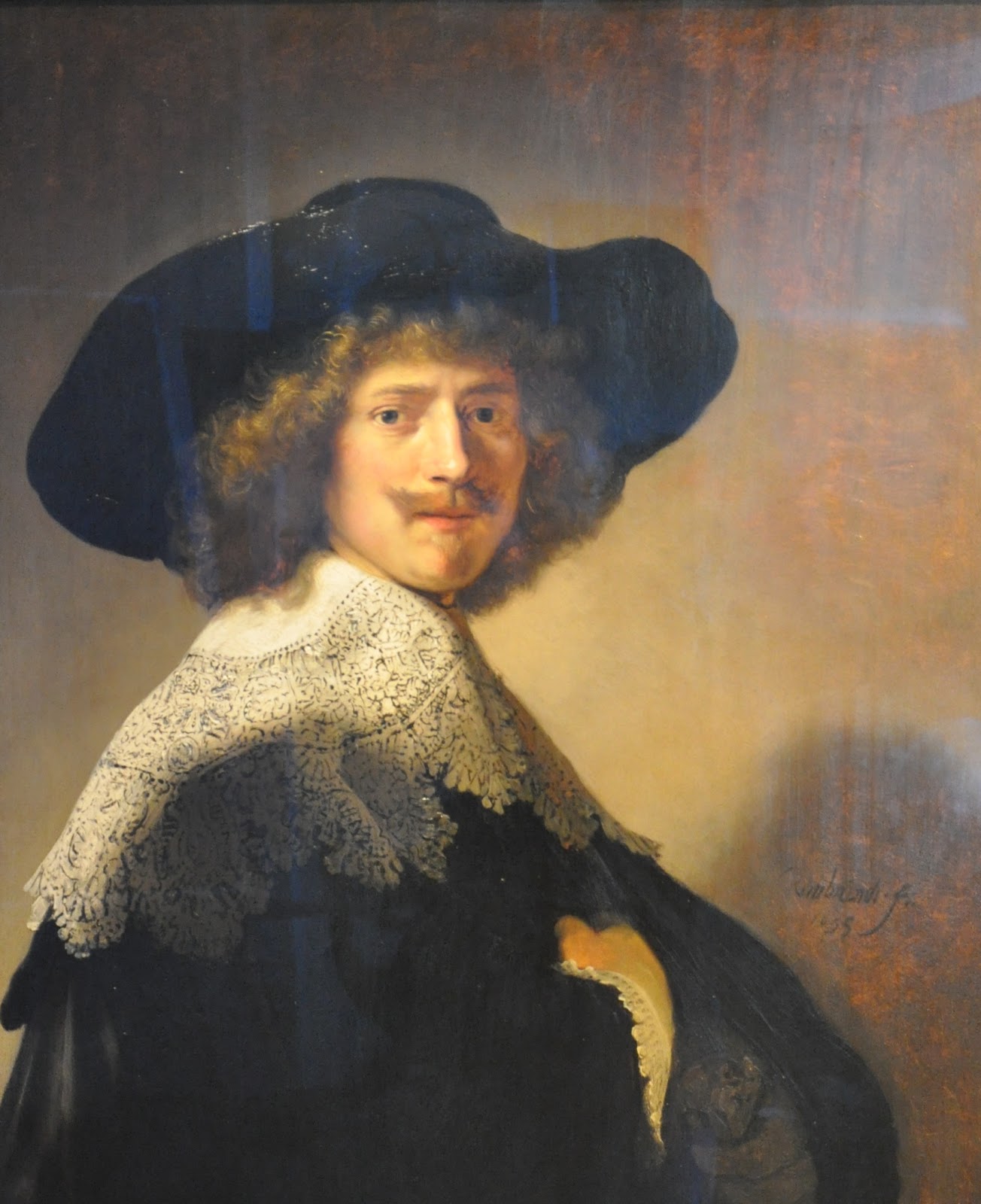
However, the highlight of my visit to Rembrandthuis last May was seeing three actual Rembrandt paintings: 


Study of an Elderly Woman in a White Cap (1640) by Rembrandt
This painting was not acknowledged as an authentic work by Rembrandt until a few years ago when the overpainting covering large parts of the painting was removed during a major restoration.


Old Man with Turban (1627) by Rembrandt
Rembrandt painted this early in his career.  He experimented with rendering light falling on the human face.  The man's face and turban are partially lit.  The way the jewel on the turban catches the light is striking.

Portrait of Anthonie Coopal (1635) by Rembrandt

Anthonie Coopal was related to Rembrandt's wife, Saskia, by marriage.  This painting has long been accepted as having been painted by Rembrandt; however, in the 1980s, the Rembrandt Research Project deattributed the painting.  Now once again, many scholars have accepted this painting as a genuine Rembrandt.

BASIC INFORMATION:
  • Rembrandthuis is located at Jodenbreestraat 4.  Take either Tram #9 or #14 to the Waterlooplein stop.  From there, it's a 5-minute walk to the Rembrandthuis.
  • Rembrandthuis is open daily.
  • Rembrandthuis is closed on January 1.
  • The current entrance fee is €10.00.
  • However, entry is free with your Museumkaart or I Amsterdam pass.
  • A free audio guide is included with your entry.
  • Photography is allowed, but no flash because of all the paintings.
For more information:website: http://www.rembrandthuis.nl/.

Thank you for visiting,

A Great Europe Trip Planner 

Photos were taken by me.

1.16.2011

WINDOW SHOPPING...

Well, it was recently that time of year where stores decorate their windows for the holidays. Walking down Michigan Avenue (aka The Magnificent Mile) in Chicago on my way to work during the Christmas holidays, I was reminded of the photos that I took of different window displays during my recent trip to Europe. Ever since we bought the fancy Nikon, I've been experimenting more with the subjects I'm photographing and the composition.

In Brussels, I really liked this display of wine goblets in a window...

And in Brugge, this housewares store had a very colorful window display...


Of course, in Amsterdam, you would see these for sale:


If you aren't sure what time it is in Brugge, check out this display:


Also in Brugge, every other window display is:


or this:


Being in Delft, you have displays of knock-off Delftware (with images of paintings by Vermeer who is from Delft):


And of course there are the food displays.
Pastries:


Candies:


Multiple flavors of gelato:


Which are created into concoctions like this: 

You can get one of these at DaVinci Ice Cream located at 34 Geldmuntstraat in Brugge.


You simply cannot visit Belgium without trying the chocolate.
The chocolate shops are as common as the lace shops:

Dumon Chocolates in Brugge cannot be missed!


And in Belgium, chocolate comes in all shapes and sizes:

1.09.2011

BEGIJNHOF: A PEACEFUL ESCAPE

In the middle of central Amsterdam, located between the busy pedestrian-only Kalverstraat and the main traffic road of Nieuwezijds Voorburgwal is a cluster of small homes surrounding a garden courtyard that has sheltered women since 1346.


The Begijnhof itself was not a convent, but an almshouse for pious laywomen (begijnen) involved in religious and charitable work, part of an order called The Beguine.

The beguines' ranks began to swell during the Crusades, when so many men took off, never to return, leaving society with an abundance of single women. Later, women widowed by the hazards of overseas trade lived out their days as Beguine. Poor and rich women alike turned their backs on materialism and marriage to live here in Christian poverty. In 1578, when Catholicism was outlawed, the Dutch Reformed Church took over many Catholic charities like this place. The last begijnen died in 1971, but the Begijnhof still provides subsidized housing to single women in need, so their privacy needs to be respected.

There is a statue of one of these charitable sisters in the courtyard:

Photo: © www.begijnhofamsterdam.nl


Photo: © Jim Forest


She faces the wooden house at #34 Het Houten Huys, one of only two surviving timber houses in Amsterdam built in 1425. (Timber houses were prohibited from being built after 1452 after a series of disastrous fires.)


The brick-faced Engelse Kerk was the Beguine church until 1607, when it became Anglican. The Pilgrims (strict Protestants fleeing persecution in England), stopped here in tolerant Amsterdam and prayed in this church before the Mayflower carried them to religious freedom in America.


Down Mariastraat away from the high-trafficked tourist sights in Brugge is another charming and restful enclave with low, white-painted gabled houses, most of which date from the 17th and 18th centuries. The houses are set around cobbled walkways shaded by tall trees and a spacious patch of grass.


Brugge's Begijnhof has occupied this same site since 1244, since its founding by Margaret of Constantinople, Countess of Flanders. Its full name is the Prinselijk Begijnhof ten Wihngaarden (Princely Beguinage of the Vineyard) because Philip the Fair, King of France, placed it under royal protection in 1299 (no one can explain the vineyard bit). The Beguines lived pious lives, doing charity work, but they were not nuns and could leave the community to marry. A Liège priest encouraged widows and unmarried women to live in communities to do the pious acts especially caring for the sick. The last of the Beguines died in 1928; the nuns seen here today are Benedictine sisters whose order took over the site in 1930. However, they have adopted the habits once worn by the Beguines.


Thank you for visiting,

A Great Europe Trip Planner 

Unless noted, photos were taken by me.

1.02.2011

NO MORE STRIPPENKAARTS...

A piece of information I've recently discovered is that in Amsterdam the strippenkaart is now obsolete.


NO LONGER USED IN AMSTERDAM.
In previous posts I wrote about using strippenkaarts on the trams throughout Netherlands, both throughout Amsterdam and when we took the tram from Den Haag and Delft.

However, now the OV Chipkaart ("OV" stands for Openbaar Vervoer which simply means public transport in Dutch) is in the process of becoming the new national public transport ticket in Netherlands and will be used on trains, metros, buses and trams. Amsterdam becomes the second Dutch city to make the OV card the only valid means of payment for public transportation. Rotterdam made the change in 2009.


This "smart card" system is slowly being rolled out throughout the country and since June 2010 (right after I returned from my trip), it has been mandatory to use on public transport in Amsterdam.

The smart card works using an embedded chip and passengers need to check-in and check-out at the start and end of the respective journeys. This is done using the special free-standing card readers
installed at platforms and on buses and trams.  There are also gate barriers in place at some metro and train stations.

There are 3 types of OV chipkaarts available: 1) Personal (for Dutch residents only); 2) Anonymous; and 3) Disposable.

The Anonymous cards are reusable, either by loading up to a €30 credit or by buying a specific travel product such as a 1 day ticket. This can be done at the service desks or at the vending machines in the stations.


There are a number of different ticket options for visitors depending on how long you are staying and where you wish to go.
  • Anonymous OV-chip card: You can buy one of these cards for €7.50 which lasts for 5 years. You can use the card as a re-chargeable "e-purse" which can be credited with up to €30. The card is used to check-in and check-out of a journey and the correct fare is deducted from your card's balance based on distance travelled.
  • Single Journey: This can be bought as a "disposable" OV card and is valid for 1 hour's travel. It costs €2.60 (or 2 for €5). It is not really good value if you are just travelling 1 or 2 stops on a tram.
  • Unlimited Travel Tickets: These are valid for a set period of times and allow you to travel on trams, buses and the metro. There are a number of different periods available for purchase depending on how long you visit the city. The longer your ticket, the better value it becomes. Current prices are:
           24 hours        (1 day)       €7.00
          48 hours        (2 days)     €11.50
          72 hours        (3 days)     €15.50
          96 hours        (4 days)     €19.50
          120 hours      (5 days)     €23.00
          144 hours      (6 days)     €26.00
          168 hours      (7 days)     €29.00

These tickets come as a disposable OV chip card or alternatively can be loaded onto an anonymous chip card. The 24-hour disposable ticket can also be bought on board trams and buses.
  • Amsterdam All-in-1 Ticket: This ticket type is very useful for tourists coming by air as it includes a return ticket (2 singles) between Schiphol airport and Amsterdam as well as an unlimited travel pass for up to 4 days. This saves a little money off the train fare and you won't have to take the time to buy a ticket to the airport.

           24 hours      (1 day)           €13.20
           48 hours      (2 days)         €17.25
           72 hours      (3 days)         €20.85
           96 hours      (4 days)         €24.45

This ticket can only be purchased at the Holland Tourist Information desk at Schiphol Airport near Arrivals Hall 2. They are open between 07:00 and 22:00.

SOME POINTS ABOUT THE OV CHIP CARD:
  • Unlike a strippenkaart, multiple-person travel is not possible. Every individual must have their own OV chipkaart. You are able to buy an anonymous card and give it to someone else to use.
  • A single fare with the disposable card in Amsterdam is €2.60. This is more expensive than using the e-purse on the personal and anonymous cards.
  • When using the e-purse, there will be a standard flat charge for boarding (€0.78 in Amsterdam) and the journey will be calculated on distance travelled (€0.104 per km) rather than the old zonal system. If you need to make a connection and board within 35 minutes of check-out you will not be charged the €0.78 base fare again.
  • When you check-in, a deposit (€4) is taken off the e-purse balance. When you check-out, the cost of the journey is deducted but you get the deposit back. If you fail or forget to check-out, you will lose the €4 deposit which will likely be more expensive than the journey cost! If you have 12 failed check-outs in a 2 week period, the card is disabled and it can only be restored by visiting a customer service desk.
  • If you are saying goodbye to someone at a station and not traveling you can check-in and check-out for free as long as your stay is within 20 minutes.
NOTE: Click on the following links for more information on public transportation in Amsterdam.