Showing posts with label paintings. Show all posts

7.16.2017

PIERRE BONNARD IN THE EAST BUILDING

Continuing on with my tour of the National Gallery of Art's East building, I exited the room with the Modigliani paintings and entered a room filled with paintings by two of my favorite painters: Pierre Bonnard and Henri Matisse.

Both artists began their careers in Paris but later they were drawn to the light and color of southern France. I love color in paintings; that's why I love the paintings of the Fauvists  and Nabis; Matisse was associated with the Fauvists; Bonnard was associated with the Nabis. These two artists' work really show how color was important to them in their works. See for yourselves...

Many of Bonnard's paintings simply focus on the everyday life around him.

Work Table (1926/1937): 
This painting was confiscated by the Nazi ERR during WWII, and selected by Herman Goering during one of his *tours* of the Jeu de Paume. It was recovered after the war and returned to France.


The Green Table (1910)


Nude in an Interior (1935): 
The detailing in this painting is remarkable: in the patterns in the wallpaper, the carpeting and the sofa.


Stairs in the Artist's Garden (1942/1944): 
This painting shows the brilliant color Bonnard found while living in the South of France.


A Spring Landscape (1935)


In the next post I will show the brilliant colors of Matisse's masterpieces.

The National Gallery of Art is located on the National Mall between 3rd and 9th Streets NW along Constitution Avenue. The entrance to the East Building is on 4th Street NW.
  • Admission is always FREE.
  • Open Monday-Saturday: 10 a.m. - 5 p.m.
  • Open Sunday: 11 a.m. - 6 p.m.
  • Closed on December 25 and January 1. 
All photos in this blog post were taken by me during my visit in June, 2017.  Unauthorized use is prohibited.

10.30.2016

PROCESSION: THE ART OF NORMAN LEWIS

Living in a major city like Chicago I try to take advantage of every opportunity presented to see an exhibition of art that I find interesting. When I saw an advertisement of a free exhibition of the work of artist Norman Lewis at the Chicago Cultural Center, I knew I wanted to see it for two reasons: the artwork itself, and the fact I had never been inside the Cultural Center, a 1897 building listed on the National Register of Historic Places.

Norman Lewis was a pivotal figure in American Art, and he was one of the innovators of the post-World War II art movement known as Abstract Expressionism. Unfortunately because he was African-American, racism prevented this talented artist from attaining the notoriety he so obviously deserved.

In his early work during the 1930s and 1940s, Lewis' work focused on what he saw in the area of Harlem where he grew up and lived.

The Wanderer (Johnny) 1933


The Dispossessed (Family) 1934


Meeting Place (aka Shopping) 1941


Hep Cats (1943): Lewis himself was a dapper dresser.


Composition I (1945): This painting was Lewis' first foray into the abstract style of painting. Although these rectangular shapes could depict an urban city such as New York City, this painting showed the painter's departure from his usual subjects of life and people living in Harlem.  He was criticized for this change in painting style.


Jazz Club (1945)
 
Fives Phases (1949)


Roller Coaster (1946)


Spring (1947)


Untitled (1949) 
Migrating Birds (1953)
Redneck Birth (1961)


Ritual (1962)
Journey (1965)


March on Washington (1965)

Exodus (1972)


Aurora Borealis (1972-1976)


Untitled (1978)


This exhibition was a real treat. I love discovering new artists and learning the struggles they incurred to have their art appreciated. I love the brilliant color Norman Lewis used in his paintings. Although his later, abstract paintings are spectacular, I like his earlier works, showing the people he encountered and their lives in 1930s and 1940s Harlem more.

This exhibition is on display at the Chicago Cultural Center until January 8, 2017. Admission is FREE. For more information click here.


Thank you for visiting.

A Great Europe Trip Planner

All photos were taken by me at this exhibition in October, 2016. Unauthorized use is prohibited.

3.22.2015

RECREATING MY OLD ART BLOG

Young Girl with Hat (1892) by Berthe Morisot at the Art Institute of Chicago


A fact of life is there is simply not enough time to do all of the things I would like to do. My goal is to do as many of them as I can with the time that I have. Unfortunately my true life goal (dream) of being a full-time travel/art blogger keeps getting interrupted because of my regular five-days-a-week job.

A few years ago I started an art blog titled: Tutti Capolavori, Art masterpieces and the artists who created them. I love art as much as I love to travel, and I wanted to share my favorite paintings that I encountered during my travels. I wrote a few posts, but my A Great Europe Trip Planner blog and my life caused me to put the art blog on hold. Well, I have decided to recreate the art blog (and correctly title it) as Tutti i Capolavori. 

I hope my art blog will interest you as much as my travel blog does. I will post notices when I have published a new post on the art blog so my travel readers will be aware of it. I have republished my original post in the new version of the blog.

Thank you in advance...A Great Europe Trip Planner.

11.23.2013

NATIONAL PORTRAIT GALLERY

On its website the National Portrait Gallery states the museum "...tells the history of America through individuals who have shaped its culture. Through the visual arts, performing arts and new media, the Portrait Gallery portrays poets and presidents, visionaries and villains, actors and activists whose lives tell the American story."

Here are some of those people...

Samuel Clemens: Who hasn't read the classic stories he wrote under his pen name Mark Twain?


Henry Clay Frick (along with his daughter, Helen): He made his fortune supplying coke for steel manufacturing; he then partnered with Andrew Carnegie to form the world's largest steel company. At his death he donated his extensive collection of European paintings to create the celebrated Frick Collection in New York City.


Andrew Carnegie: He sold his Carnegie Steel Company to J.P. Morgan which created U.S. Steel. Having built one of the world's largest fortunes, Carnegie gave away over $350 million during his lifetime, 90% of his fortune: He stated, "The individual who amasses great wealth must in the end apply his fortune for the benefit of all."


Daniel Boone: Boone spent his life pushing westward, always dissatisfied with where he was. Eventually he ended up in Kentucky, opening that area for white settlement. One reason Boone kept moving was that when the government caught up with him on the trail he had blazed, it usually voided his land claims and expelled him. Although the reality of Boone's career did not embody the romantic legend others applied to it, the persistence of Boone as a symbol indicates how strongly the idea of a lone frontiersman shaped American history.

Dave Crockett: Unlike Daniel Boone, Crockett created a totally different image of the frontiersman: a jocular, colorful type who liked tall tales and whiskey. Crockett was a soldier, state representative from Tennessee, an author and a road showman. He is however most noted for fighting, and dying, in the Battle of Alamo.


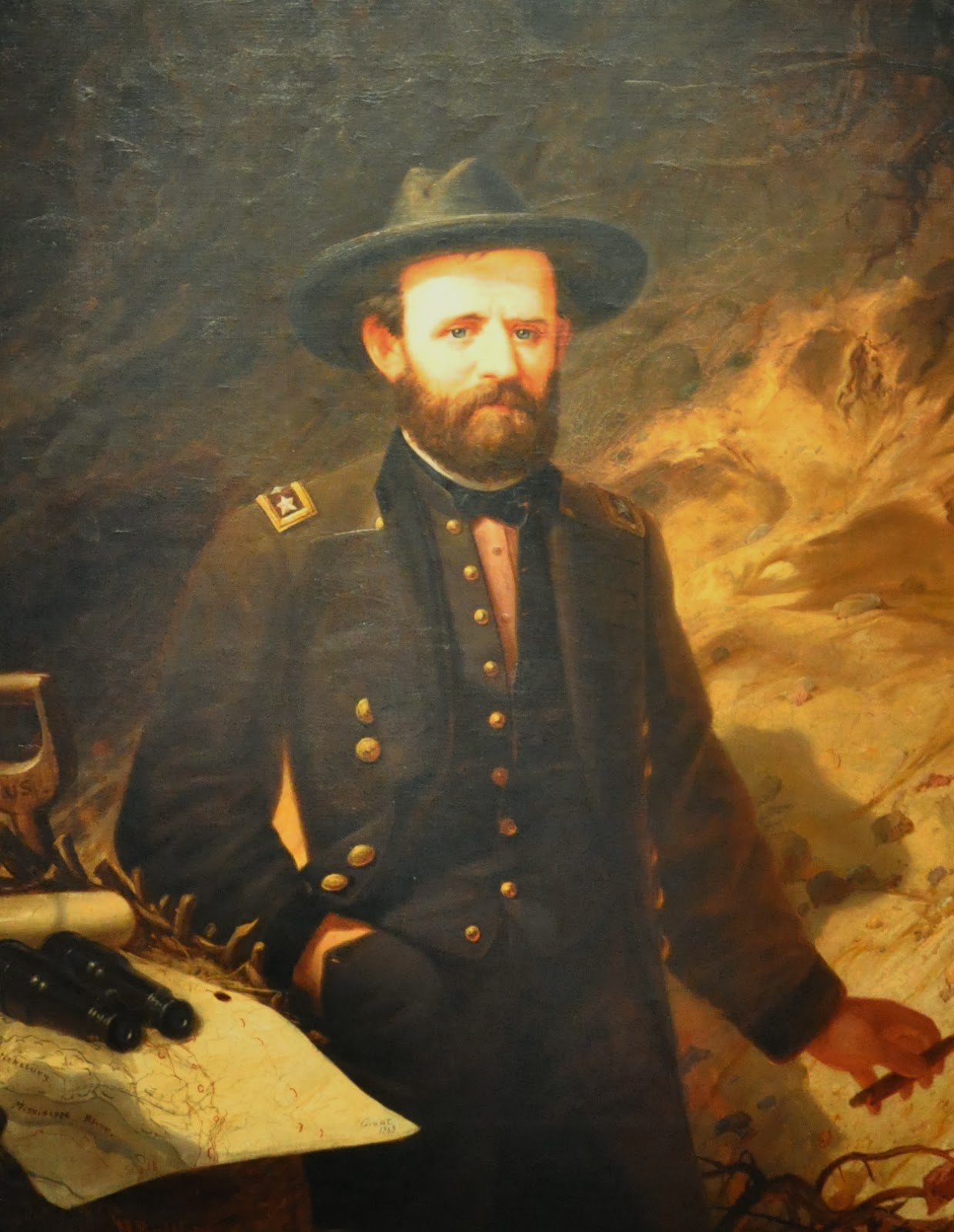
Ulysses S. Grant: Not interested in the military, Grant only entered West Point to receive an education. Unsuccessful in business ventures, he reentered the military at the beginning of the Civil War. Eventually President Lincoln made him commander of the entire Union Army. He was elected to two terms as president.


The National Portrait Gallery presents the wonderful diversity of individuals who have left, and are leaving, their mark on our country and our culture. In my next blog post I'll show you a few more.

Admission is always FREE at the National Portrait Gallery. Click here to visit the National Portrait Gallery's website. 

All photos in this blog post were taken by me during my visit in September, 2013.

11.05.2013

FAMILIAR AT THE FIGGE

The Figge is a small, but wonderful art museum located in Davenport, Iowa, one block from the mighty Mississippi River.

There were paintings by artists that I was familiar with...

Flower Vase on a Table (1942) by Pablo Picasso


Still Life with Fruit (1920-1922) by Georges Braque


Note the grains of sand in the paint...

Carnival (1943) by Max Beckmann
 

According to his diary, Beckmann painted this triptych while in exile in Amsterdam. If you have followed my blog, you will remember that as a Jew, Beckman's art was considered degenerate by Adolf Hitler. Beckmann lost his teaching position and many of his paintings were confiscated.

Spanish Woman with Mantilla (1910) by Alexej von Jawlensky


Although Russian by birth, Jawlensky lived for several years in Germany; he was an acquaintance of Expressionist painters Gabriele Münter and Emil Nolde, and Wassily Kandinsky and Henri Matisse.

The Blue Horse (1926-1928) by Marc Chagal


Marc Chagall is considered the pioneer of Modernism. He is known for using vibrant, saturated colors applied in complex layers.

Street in Paris, Pink Sky (1909) by Lyonel Feininger


Although American-born, Feininger lived in Germany and was associated with many of the German Expressionist groups. Unfortunately he also suffered the same fate as other Expressionist artists during the Nazi years, and was forced to return to the United States.

Black Hat on a Yellow Chair (1952) by Fernand Lèger


A card-carrying member of the Communist Party, Lèger was influenced by Cubism and utilized mechanical-like forms and primary colors.

A Drop of Dew Falling from the Wing of a Bird Awakens Rosalie Asleep in the Shade of a Cobweb (1939) by Joan Miró.  Yes, that is the entire title of this painting.


All of these paintings are part of a current exhibition at the Figge entitled A Legacy for Iowa. The exhibition features some of the most important works of art from the University of Iowa Art Museum. You can read more here.

All photos in this blog post were taken by me during my visit to the Figge Art Museum in October, 2013.